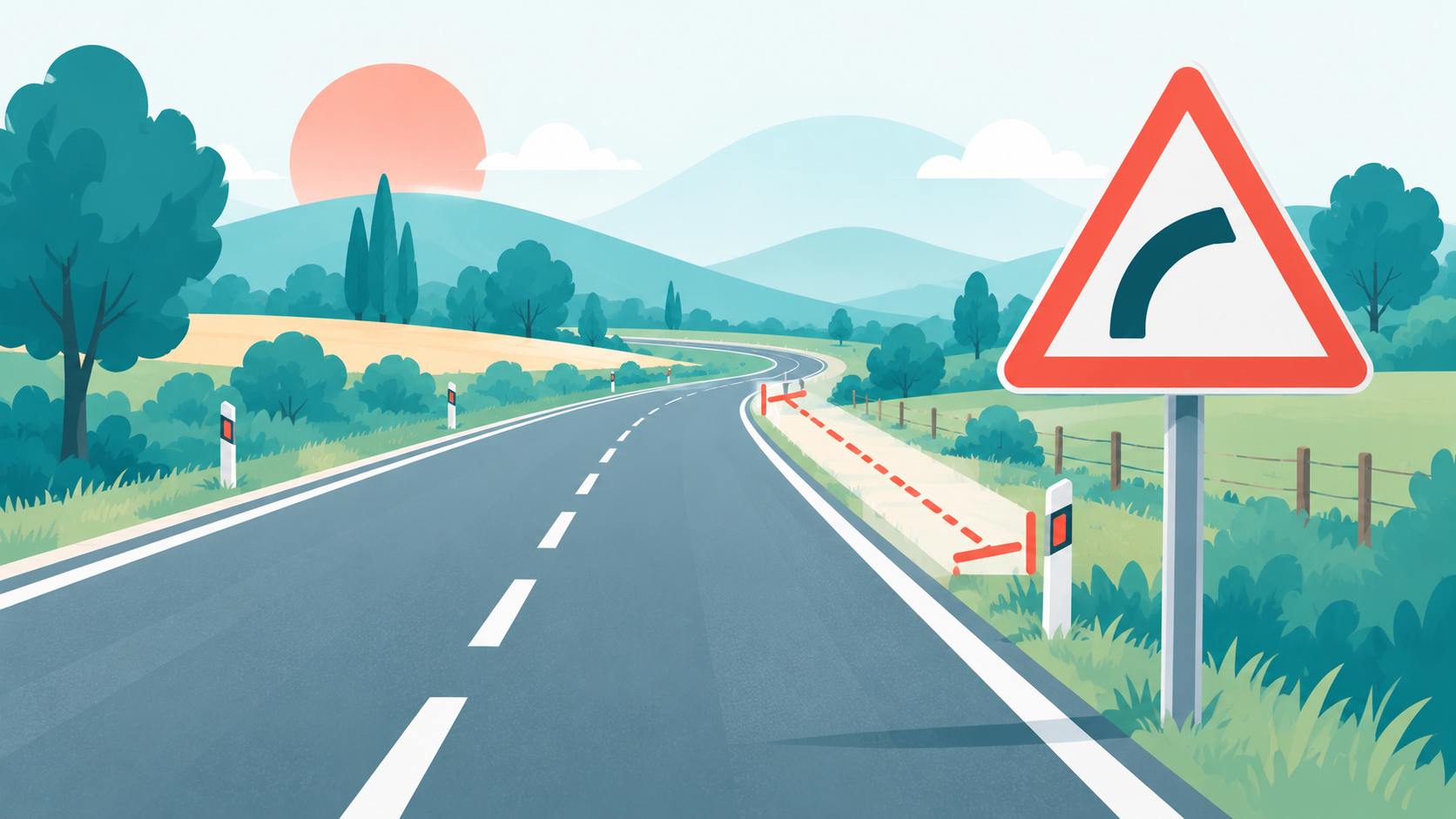
📌 In short: Italian danger signs are triangular with the point upward and a red border. Outside built-up areas they stand as a rule 150 metres before the hazard (inside towns the distance can be shorter). They require you to slow down and pay extra attention — not to stop. They are among the most frequent topics in the ministerial quizzes.
Sources: Italian Highway Code (arts. 39–43 and implementing regulation), ministerial question list, SuperQuizPatente internal statistics
The basic rules the quizzes take for granted
| Feature | Rule |
|---|
| Shape | Triangle pointing upward, red border |
| Distance from the hazard (rural roads) | As a rule, 150 metres |
| In built-up areas | Distance can be shorter (limited space) |
| With a distance panel underneath | The panel's distance applies |
| What they require | Slow down and pay attention — not stop |
| Shape exceptions | The St Andrew's cross and level-crossing signs |
"As a rule" is the key phrase: the quizzes love asking whether the 150 metres apply always (false — in towns and with distance panels it changes). You'll find every sign with its full rules in the article-by-article theory section.
The danger signs that appear most in the quizzes
- Bump ("dosso") — an uphill crest limiting visibility; overtaking near the crest is banned on two-way single-carriageway roads.
- Dip ("cunetta") — a hollow in the road: slow down; it is not a ban on driving through.
- Dangerous bend (left/right) and double bend — the arrow shows the direction of the first bend.
- Slippery road — the classic quiz asks whether it only applies in rain (false: also ice, mud, leaves).
- Pedestrian crossing vs children — "children" signals schools or play areas nearby, not a pedestrian crossing: two different signs.
- Steep descent/ascent — the percentage is the gradient; downhill, use engine braking.
- Road narrows — symmetric or one-sided: it warns of the narrowing but does not by itself assign priority.
- Wild/free-roaming animals — slow down, especially at night.
The recurring traps in the questions
"The sign obliges you to stop" — almost always false: danger signs demand caution, not an arrest. "It always stands 150 metres before" — false; the rule is "as a rule", outside built-up areas. "It prohibits transit" — false: prohibiting is the job of round prohibition signs, not triangles. And don't confuse "children" with "pedestrian crossing". Whenever a question says "always", "never" or "prohibits", pause a second — that's where most candidates fall, as our most-failed questions statistics show.
How to study them without going mad
Signs aren't memorised one by one: they're learned by family. First the logic (triangle = danger, red circle = prohibition, blue circle = obligation), then the special cases. In the topic-based quizzes you can drill danger signs alone until you hit zero errors — it's the topic with the best study-to-points ratio in the whole exam, because the questions are visual and highly repetitive. Finish with the full simulation to make sure signs don't eat your timer.
❓ Frequently asked questions
How far before the hazard do Italian danger signs stand?
Outside built-up areas, as a rule 150 metres before the hazard; in towns the distance can be shorter, and if a distance panel is attached, the panel's figure applies.
What shape are Italian danger signs?
Triangular with the point upward and a red border, with a few exceptions such as the St Andrew's cross and the level-crossing signs.
Do danger signs oblige you to stop?
No: they require you to slow down and increase attention. Mandatory stopping belongs to other signs, such as Stop.
What is the most common quiz mistake on danger signs?
Falling for absolute wording: "always 150 metres" is false (it's "as a rule"), "prohibits transit" is false (prohibitions are round signs), and the "children" sign does not mark a pedestrian crossing.
What is the best way to study Italian road signs?
By logical family (triangle = danger, red circle = prohibition, blue circle = obligation), then topic-based quizzes until zero errors: it is one of the most repetitive, highest-yield topics of the exam.
🚦 Practise with real exam quizzes
Done with the theory? Test yourself on 7,000+ official Ministry questions — in English or Italian.
📝 Start now with SuperQuizPatente