
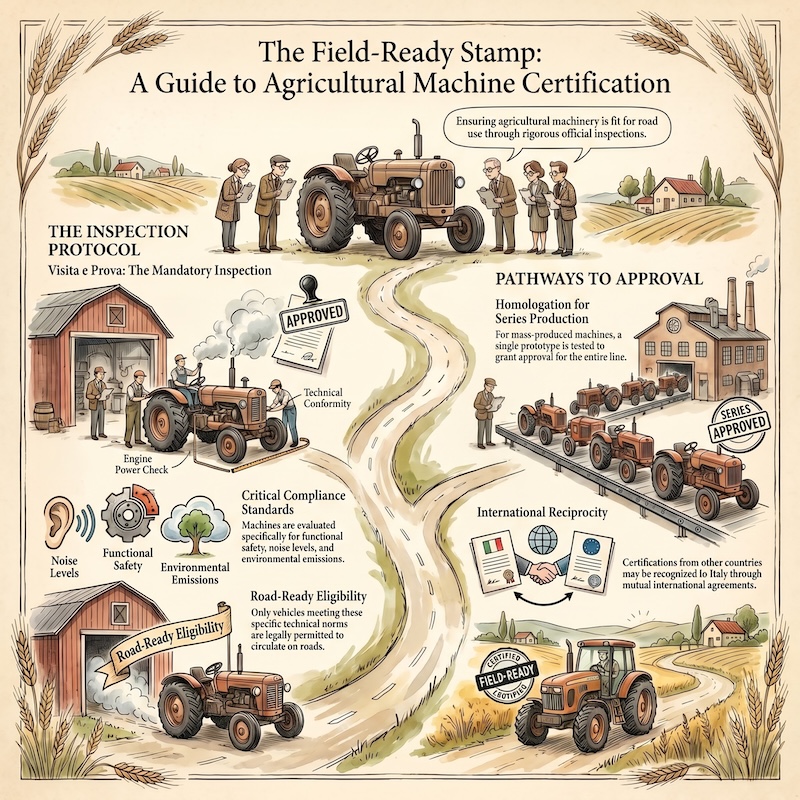
Agricultural machines must undergo official checks to verify that they are suitable for road circulation. These checks include several key aspects: the identification data of the vehicle, the engine power when applicable, and compliance with technical requirements established by law. In practice, this ensures that the machine is built and equipped according to the necessary standards for safe and proper operation. Some specific categories of towed agricultural machines may be exempt from these checks, as defined by regulations.
The verification of suitability is carried out through a process known as “inspection and testing.” This means that the machine is examined and tested by competent authorities from the Department for land transport or by authorized entities that meet specific technical requirements. During this process, it is confirmed that all systems function correctly and that the vehicle complies with regulations on safety, emissions, and noise. The exact procedures for these inspections are defined by ministerial decrees.
When agricultural machines or their components are produced in series, it is not necessary to inspect every single unit. Instead, a system of type approval is used: a prototype is tested, and if it meets all requirements, the approval is extended to all units of the same type. This ensures consistency and compliance across all produced machines without the need for individual testing.
Finally, if an agricultural machine has already been approved in another country, this approval may be recognized as valid in Italy, provided there is a reciprocal agreement between the countries. This facilitates international trade and use of agricultural machinery while maintaining high standards of safety and environmental protection.
Studied the theory? Test yourself with 7,000+ official Italian Ministry questions.
📝 Start now with SuperQuizPatente