
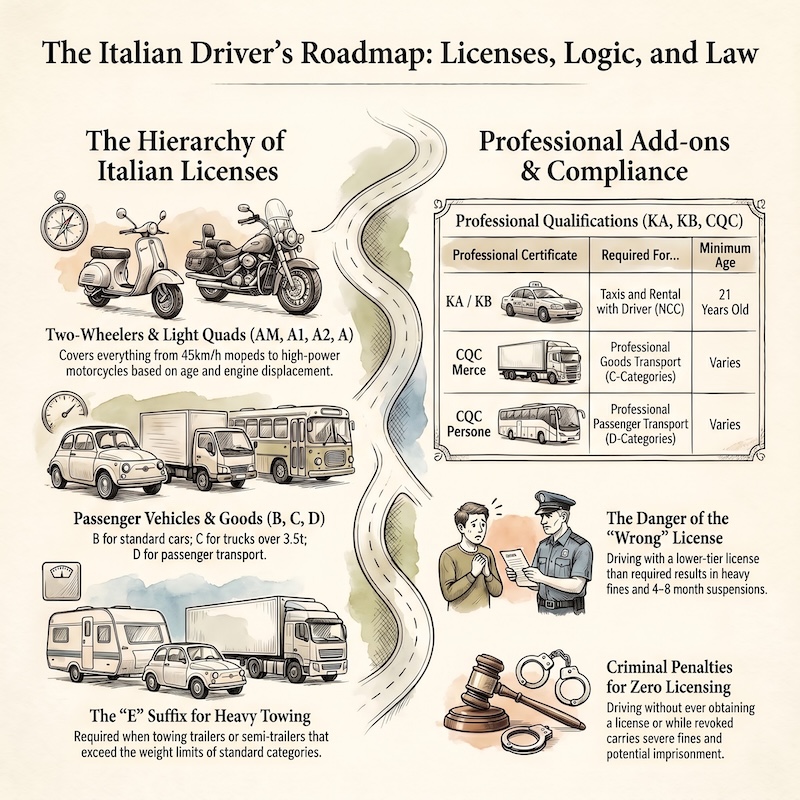
To drive mopeds, motorcycles, tricycles, quadricycles and motor vehicles, it is necessary to hold the correct driving licence and, when the law requires it, an additional professional permit. Driving licences and professional authorisations are issued by the competent authority to people who are resident in Italy. To obtain a licence, a person must submit an application, pass the required exams and meet the physical and mental fitness requirements laid down by law.
The Italian driving licence follows the European Union model and is divided into categories. Category AM allows the holder to drive two-wheel mopeds up to 45 km/h, three-wheel mopeds up to 45 km/h and light quadricycles with specific limits of mass, engine capacity or power. In practical terms, this category covers light and low-speed vehicles such as small mopeds and certain light microcars.
The A1 licence allows the holder to drive motorcycles up to 125 cm³, with a maximum power of 11 kW and a power-to-weight ratio not above 0.1 kW/kg. It also allows the driving of tricycles up to 15 kW. The A2 licence allows motorcycles with power not above 35 kW and a power-to-weight ratio not above 0.2 kW/kg, provided that the vehicle is not derived from a model producing more than double that power. The A licence allows the driving of all motorcycles and also tricycles above 15 kW, subject to the legal age requirements.
Category B1 allows the driving of quadricycles other than the light ones included in category AM, within the legal limits on mass and power. Category B allows the driving of motor vehicles with a maximum authorised mass not exceeding 3500 kg and designed to carry no more than eight passengers in addition to the driver. With a B licence, it is possible to tow a trailer up to 750 kg. A heavier trailer may also be towed, provided that the maximum authorised mass of the whole combination does not exceed 4250 kg. If the combination exceeds 3500 kg, a specific driving test is required and an appropriate European code is added to the licence. In some cases, a B licence also allows the driving of goods vehicles powered by alternative fuels with a maximum authorised mass above 3500 kg but not above 4250 kg, if the extra weight comes only from the propulsion system and the driver has held the B licence for at least two years.
The BE licence is required for combinations made up of a category B vehicle and a trailer or semi-trailer with a maximum authorised mass not exceeding 3500 kg. Categories C1 and C mainly concern vehicles used for carrying goods. C1 allows vehicles over 3500 kg and up to 7500 kg, carrying no more than eight passengers in addition to the driver, and a trailer up to 750 kg. C allows vehicles over 3500 kg without the 7500 kg upper limit, again with no more than eight passengers in addition to the driver, and with a trailer up to 750 kg.
Categories C1E and CE concern vehicle combinations. C1E allows a C1 vehicle with a trailer above 750 kg, provided that the whole combination does not exceed 12000 kg. It also covers certain combinations formed by a category B vehicle and a very heavy trailer or semi-trailer, again within the total limit of 12000 kg. CE allows a category C vehicle with a trailer or semi-trailer above 750 kg.
Categories D1 and D concern passenger transport. D1 allows vehicles designed to carry no more than 16 people in addition to the driver, with a maximum length of 8 metres, and with an optional trailer up to 750 kg. D allows vehicles designed to carry more than eight passengers in addition to the driver, again with a trailer up to 750 kg. D1E and DE are the corresponding categories for those vehicle combinations with trailers above 750 kg.
People with physical disabilities may obtain special licences in many categories, including AM, A, B, C and D, provided that they pass the required medical assessments. A special licence may contain restrictions, for example the obligation to use an adapted vehicle or special controls. These limitations are shown on the licence by means of codes. A holder of a special B licence is not allowed to drive ambulances.
A person who passes the practical test on a vehicle with automatic transmission may drive only vehicles with automatic transmission, because the licence will contain that restriction. For motorcycles, the rule refers to the absence of the clutch controls specified by law. The licence may later be extended to other categories, but only after further checks of physical and mental fitness and, where required, another examination. In addition, a person may hold only one driving licence issued by a Member State of the European Union or the European Economic Area.
For some professional services, the driving licence alone is not enough. A person who carries out chauffeur-driven hire services or certain public transport services with specific vehicles must also hold a professional certificate. Certificate KA is required when the service is carried out with vehicles for which A1, A2 or A is required. Certificate KB is required when the service is carried out with vehicles for which B1 or B is required. To obtain these certificates, the driver must be at least 21 years old, hold the required licence and have successfully completed a first aid course.
For the professional transport of goods or passengers, a Driver Qualification Card may also be required. In general, holders of categories C1, C, C1E and CE need it for the transport of goods, while holders of categories D1, D1E, D and DE need it for the transport of passengers. For the transport of schoolchildren, this qualification is always required. In some specific professional transport activities governed by international agreements, other certificates of competence, qualification or training may also be necessary.
If a person changes residence or changes address within the same municipality, the update is recorded in the official systems through communication from the municipality to the national register of licensed drivers. This means that the data linked to the driving licence are officially updated.
It is very important not to entrust a vehicle to someone who does not hold the correct licence or the required professional qualification. Anyone who gives a vehicle to, or allows it to be driven by, a person who is not properly authorised commits an administrative offence and is subject to a fine. Even more serious is driving without ever having obtained the required licence, or driving with a licence that has been revoked or not renewed because of missing physical or mental requirements. In those cases, criminal penalties apply, the fines are very high and, if the offence is repeated within two years, arrest of up to one year may also follow.
Driving with a lower category than the one required is also a serious violation. For example, if a person with an A1 licence drives a vehicle requiring A2, or a person with A1 or A2 drives a vehicle requiring A, or a person with B1, C1 or D1 drives vehicles requiring B, C or D respectively, that person is subject to a heavy administrative fine and suspension of the licence already held for four to eight months.
If the driver has a licence but does not have the additional professional qualification required in specific cases, an administrative fine still applies. In addition, some of these violations lead to the administrative detention of the vehicle. When someone drives without a licence, the vehicle may be detained for three months and, in the event of repeat offending, it may even be confiscated. If the driver is missing only the required professional qualification, the vehicle may be detained for sixty days.
For exam preparation, it is essential to remember that each licence category corresponds to specific vehicles identified mainly by mass, power, number of passengers and trailer. It is also important to remember that, for certain professional uses, the ordinary driving licence is not enough and additional certificates or qualifications may be required. Driving without the correct legal authorisation, or allowing another person to do so, can lead to very serious consequences.
Studied the theory? Test yourself with 7,000+ official Italian Ministry questions.
📝 Start now with SuperQuizPatente