
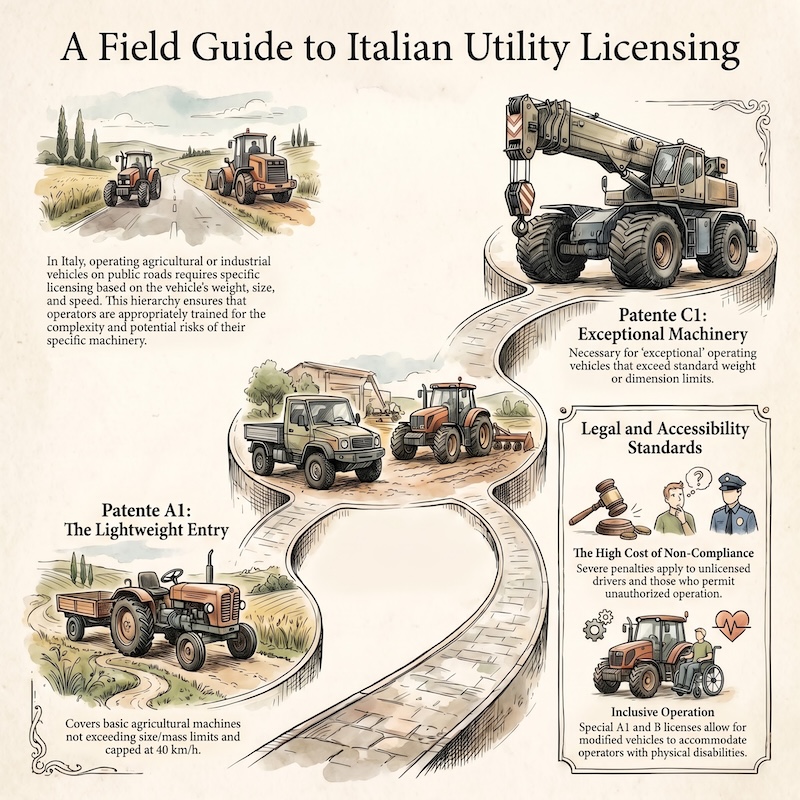
To drive agricultural machines and work machines on the road in Italy, it is not enough simply to know how to operate the vehicle. A person must hold a driving licence suitable for the category and characteristics of the vehicle. The law distinguishes between different types of machines and connects each of them to a specific licence category. This is meant to ensure that the driver has preparation appropriate to the vehicle’s size, weight, speed, and the specific difficulties involved in driving it.
For agricultural machines, excluding those controlled by a person walking on the ground, a category A1 licence is sufficient only in limited cases. This licence allows the driver to operate agricultural machines, or combinations of agricultural machines, that do not exceed the legal size and weight limits and that cannot go faster than 40 km/h. In practice, the A1 licence is sufficient only for less demanding agricultural vehicles, meaning vehicles that are not too large, not too heavy, and not too fast.
When the agricultural machine exceeds those limits, or when the vehicle is a work machine, a category B licence is required. This means that the B licence is not used only for cars, but also authorizes the driving of agricultural machines that are more demanding than those allowed with A1, as well as ordinary work machines. Work machines are vehicles mainly intended to carry out specific jobs rather than transport, and because of their characteristics they require a higher qualification than simpler agricultural machines.
Exceptional work machines require a category C1 licence. These are vehicles that, because of their size, weight, or special features, fall into the category of exceptional vehicles. In these cases, driving requires even higher preparation, because the vehicle may present greater manoeuvring difficulties and greater risks in road traffic.
The law also considers persons with physical impairments or disabilities. A decree of the Ministry of Infrastructure and Transport establishes which types of agricultural and work machines may be driven with special licences of categories A1 and B, possibly with adapted vehicles. This means that persons with physical disabilities may also be authorized to drive these vehicles, provided that the vehicle is compatible with their condition and, where necessary, properly adapted.
If no particular adaptation is required, the same decree identifies the types and characteristics of the vehicles that may be driven by persons with physical impairments without specific modifications. In other words, the possibility of driving is assessed according to the type of vehicle and the driver’s condition, with the aim of balancing safety and accessibility.
Anyone who drives agricultural machines or work machines without the required driving licence commits a serious violation. In this case, the penalties provided by the general rules on driving without a licence apply. The same is true for anyone who carelessly entrusts these vehicles to a person who does not have the necessary licence. This principle is important because the law punishes not only the unauthorized driver, but also the person who allows or tolerates unauthorized driving.
In summary, to drive agricultural machines and work machines on the road, it is always necessary to check which licence is required for the specific type of vehicle. Simpler agricultural machines may be driven with an A1 licence, many others require a B licence, while exceptional work machines require a C1 licence. The key rule to remember is that these vehicles are not all driven with the same licence, and the required category depends on the actual characteristics of the vehicle.
Studied the theory? Test yourself with 7,000+ official Italian Ministry questions.
📝 Start now with SuperQuizPatente