
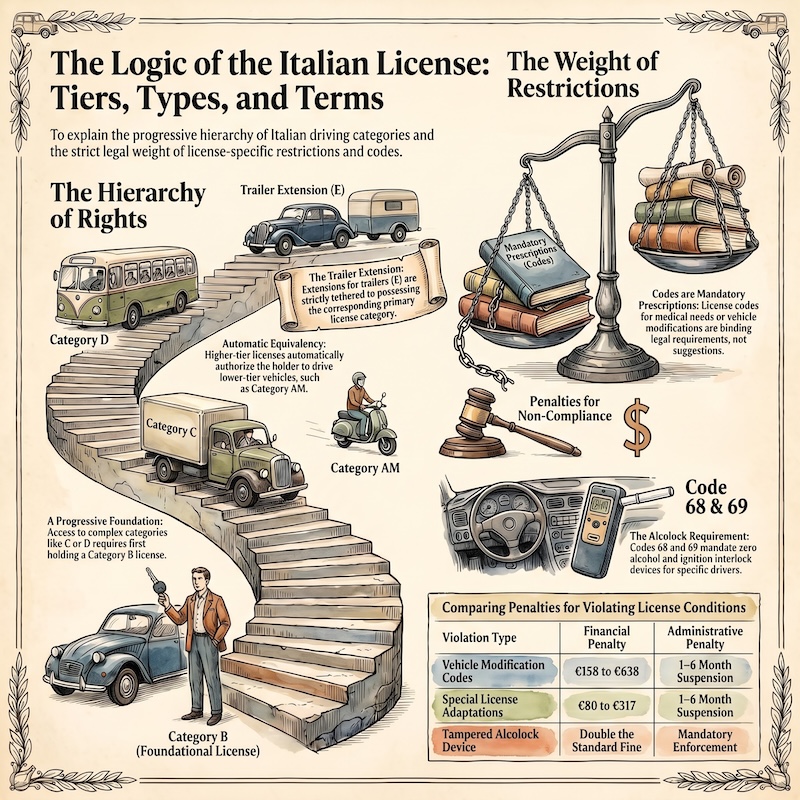
In Italy, obtaining certain driving licence categories is not possible directly without prior requirements. Some categories may be issued only to drivers who already hold a lower or basic category. For example, categories C1, C, D1, and D may be issued only to those who already hold category B. In the same way, licences for trailers or vehicle combinations, such as BE, C1E, CE, D1E, and DE, may be issued only to those who already hold the corresponding main category. This means that the driving licence system is progressive: first the basic category is obtained, then the driver may move on to more complex categories.
The law also states that some licences automatically include the validity of other categories. A person who holds a higher category licence can often drive vehicles belonging to lower or related categories as well. For example, a licence for categories C1E, CE, D1E, or DE is also valid for category BE vehicle combinations. A CE licence is also valid for DE, but only if the driver already holds category D. In addition, CE and DE are also valid respectively for C1E and D1E. This system avoids the need for a driver to obtain lower categories again after already passing tests for more demanding ones.
Any driving licence, regardless of category, is also valid for vehicles of category AM. This means that a person who holds a licence for cars, motorcycles, trucks, or buses may also drive the lighter vehicles included in AM. Likewise, a category A2 licence is also valid for A1, while categories A, B, C, and D are respectively valid also for A1 and A2, B1, C1, and D1. In practice, a higher category licence normally includes the right to drive the related lower categories as well.
For persons with physical impairments or disabilities, special driving licences exist. These licences are not valid in a general way for all vehicles of that category, but only for vehicles having the characteristics indicated on the licence itself. This means that the driver may drive only vehicles compatible with their physical condition and with any required adaptations. A special licence is therefore closely linked to the authorized type of vehicle and does not allow free driving of every vehicle in the same category.
A category B licence, within Italy, also allows the driving of tricycles with power above 15 kW, but only if the holder is at least 21 years old. In addition, a B licence is also valid for category A1 vehicles. This is important because it shows that, in some cases, the car licence also allows the driving of vehicles that are not cars, provided that the legal conditions are satisfied.
A driving licence may contain European or national codes indicating particular driving conditions. Some codes concern vehicle modifications, while others concern the driver for medical reasons. These codes are not merely informative notes, but mandatory prescriptions. If the driver operates a vehicle or circulates under conditions different from those indicated by those codes, a violation is committed. In other words, anyone whose licence contains limitations must always respect them, because they form an integral part of the authorization to drive.
When the licence includes codes related to vehicle modifications, the driver must use a vehicle that complies with those requirements. For example, if the licence requires special adaptations or devices, it is not permitted to drive an ordinary vehicle without those characteristics. If this rule is violated, an administrative fine from 158 to 638 euros applies. In addition to the fine, the driving licence is also suspended for a period from one to six months.
For licences containing codes related to the driver for medical reasons, driving under conditions different from those authorized leads to the penalties provided by the relevant rules. Here too, the principle is that medical prescriptions are not optional. If the licence imposes a certain condition, the driver must respect it every time they drive.
The law also contains specific rules for drivers whose licence bears codes 68 and 69. Code 68 means absolute prohibition of alcohol, while code 69 means that driving is allowed only in vehicles equipped with an alcolock device compliant with European technical standards. In these cases, within the national territory, the driver may operate vehicles of international categories M or N only if the vehicle is equipped with a functioning device that prevents the engine from starting when the driver’s blood alcohol level is above zero. The device must be installed at the driver’s expense, according to specific technical rules, and must be protected by seals to prevent tampering.
If a driver with these codes drives under different conditions from those imposed, the sanctions provided by law apply. If the vehicle lacks the alcolock, or if the device is altered, tampered with, not functioning, or the seals have been removed, the same sanctions apply in double measure. This shows that the law considers non-compliance with these limitations particularly serious.
Anyone holding a special licence who drives a vehicle different from the one indicated on the licence, or a vehicle not adapted to their physical needs, or a vehicle with characteristics different from those authorized, is subject to an administrative fine from 80 to 317 euros. In this case too, suspension of the licence from one to six months is added. The fundamental rule is that a special licence authorizes driving only within the exact limits stated on the licence.
In summary, the law establishes both how the various licence categories are connected and what limits must be respected when the licence contains particular prescriptions. Some licences automatically include lower categories, but whenever codes, adaptations, or medical limitations are present, the driver must strictly follow what is written. A driving licence does not authorize driving in a general and unlimited way, but only within the precise limits set by the category held and by any conditions shown on the document.
Studied the theory? Test yourself with 7,000+ official Italian Ministry questions.
📝 Start now with SuperQuizPatente