
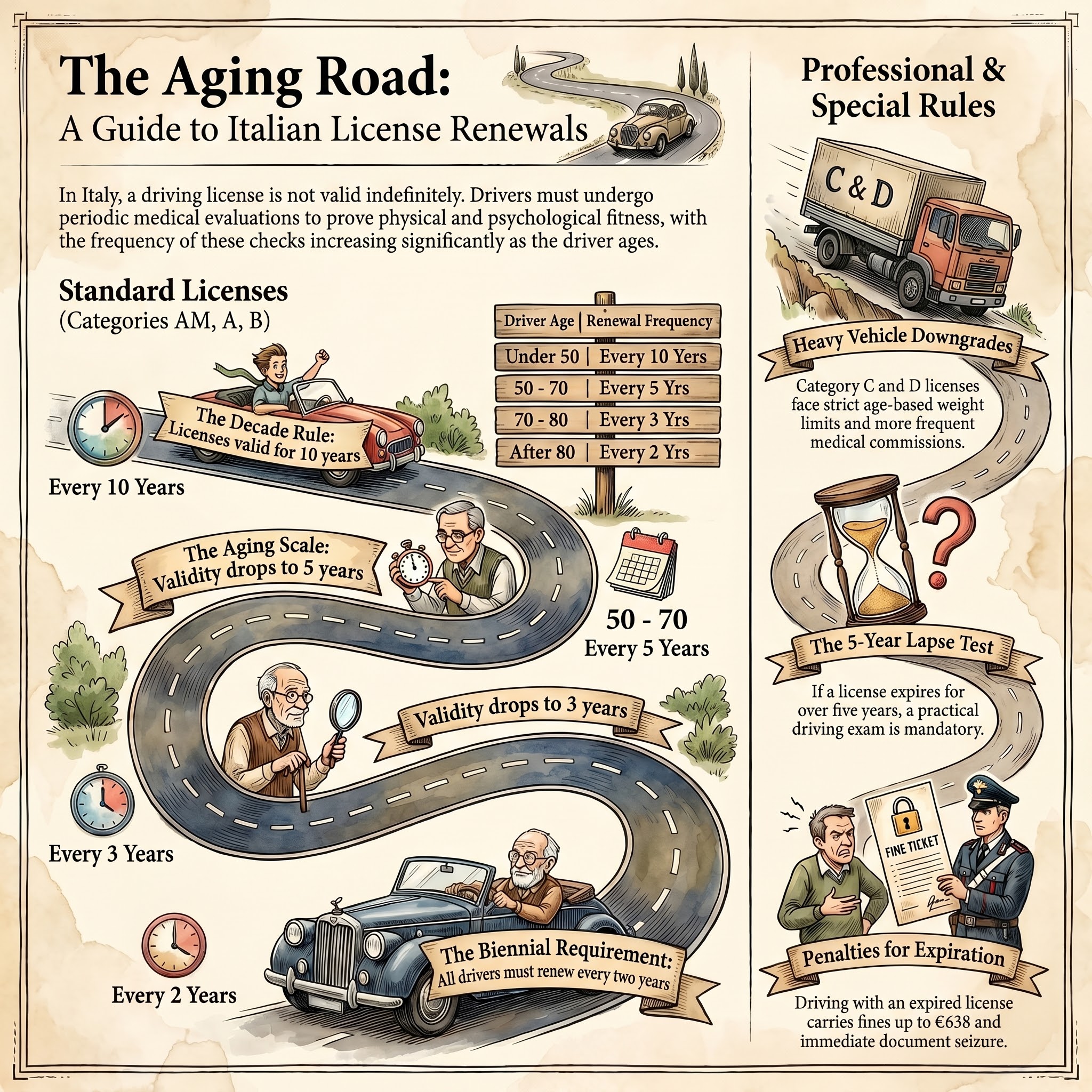
A driving licence is not valid forever. To continue driving legally, the driver must renew it periodically and prove that they still have the physical and mental requirements needed for safe driving. The same principle also applies to certain professional certificates linked to the licence. In other words, obtaining a licence once is not enough for life, because the law requires periodic checks to confirm that the driver is still fit to drive.
For licences of categories AM, A1, A2, A, B1, B, and BE, the normal validity period is ten years. However, if the licence is issued or renewed for a person who is already over fifty years old, the validity is reduced to five years. After the age of seventy, the validity is reduced further to three years. This means that, with increasing age, checks become more frequent because the law considers it necessary to verify driving fitness more often.
For licences of categories C1, C1E, C, and CE, validity is five years until the age of sixty-five. After sixty-five, validity is reduced to two years, and renewal also requires verification of physical and mental fitness before the local medical commission. In addition, from the age of sixty-five, categories C and CE allow the driving of road trains and articulated vehicles only if their maximum authorized total mass does not exceed 20 tonnes. This therefore creates not only a shorter renewal period but also a limitation on the vehicles that may be driven.
For categories D1, D1E, D, and DE, the validity is five years and becomes three years from the age of seventy onward. In addition, after the age of sixty, these licences no longer allow the holder to drive the vehicles for which they were originally required, but only vehicles for which category B or BE is sufficient. In practice, after a certain age the licence does not necessarily expire completely, but it may become limited to lower categories of vehicles. The holder may also request reclassification of a D1 or D licence into B, or of a D1E or DE licence into BE.
Special licences issued to persons with physical disabilities for categories AM, A1, A2, A, B1, and B are valid for five years. If issued or renewed for persons over seventy years old, they are valid for three years. For special licences of categories C1, C, D1, and D, the same rules apply as for the corresponding ordinary higher categories. This means that the duration of a special licence depends both on the category and on the driver’s age.
After the age of eighty, the rule becomes stricter. All holders of the licences mentioned by law must renew their licence every two years. This applies regardless of which of the indicated categories they hold. The purpose is to ensure closer checks at an age when physical and mental conditions may change more quickly.
For professional certificates of type KA and KB, the check of physical and mental fitness must be carried out every five years and, in any case, also when the driving licence is renewed. Anyone holding these qualifications must therefore remember that the professional authorization also requires periodic checks and is not renewed automatically without them.
As a general rule, confirmation of licence validity is handled by the competent central office of the Department for Sustainable Mobility. After the medical examination, the doctor or the medical commission sends the required data to the office, which then sends the holder a duplicate licence showing the new expiry date. Once the new document is received, the driver must destroy the expired licence. In addition, the medical examination cannot be carried out if the driver does not prove that the required renewal fees have been paid.
When renewal takes place before the local medical commission, a provisional driving permit may be issued only once and is valid until the renewal process is completed. This permit is granted only if no impediments appear in the national register of licensed drivers. However, the provisional permit is not issued to drivers who must undergo checks provided for in cases of driving under the influence of alcohol or drugs.
If a licence has been expired for more than five years, an ordinary renewal is not enough. In that case, the driver must also pass a driving test intended to show that they still have the technical ability to drive. To allow driving until the day of the test, the office issues a booking receipt, provided the driver presents the required medical certificate. The driving test consists of carrying out at least one manoeuvre and at least three driving behaviours in traffic chosen from those required for the practical test of the same licence category.
If the result of this test is negative, the licence is revoked on the same day. If the holder does not appear for the test, the licence is suspended from the following day until a new driving test requested by the person is successfully passed. This means that allowing a licence to remain expired for many years can have very serious consequences, including the loss of the licence itself.
For holders of an Italian driving licence who live or stay abroad for at least six months, validity may also be confirmed by Italian diplomatic or consular authorities, except in certain special cases requiring different procedures. In that case, the medical assessment is performed by doctors trusted by the Italian embassies or consulates, who issue a certificate valid during the period of stay abroad. However, anyone who renews the licence through an Italian consular authority in a country outside the European Union or the European Economic Area must, within six months of re-establishing residence in Italy, renew the licence again through the ordinary Italian procedure.
If medical examinations show that the driver no longer has the necessary requirements, the health authority informs the competent office, which then adopts the measures provided by law, such as suspension or revocation of the licence. In some cases, the local medical commission may also decide that the driver should not lose the licence completely, but should move to a lower category. In that case, the data are sent to the central office, which prints and sends the reclassified licence.
Anyone who drives with an expired licence is subject to an administrative fine from 158 to 638 euros. In addition to the fine, the expired licence or professional authorization is also withdrawn. For persons carrying out professional transport activities with an expired authorization, the specific sanctions provided by the professional transport rules also apply. In other words, driving with an expired licence is not just a formal irregularity, but a violation with real and immediate consequences.
In summary, the duration of a driving licence depends on its category, the driver’s age, and in some cases the driver’s health conditions. Renewal is not automatic, but requires medical checks and, in special situations, also a practical driving test. The fundamental rule to remember is that a person may drive only with a still-valid licence and with physical and mental fitness that continues to be adequate.
Studied the theory? Test yourself with 7,000+ official Italian Ministry questions.
📝 Start now with SuperQuizPatente