
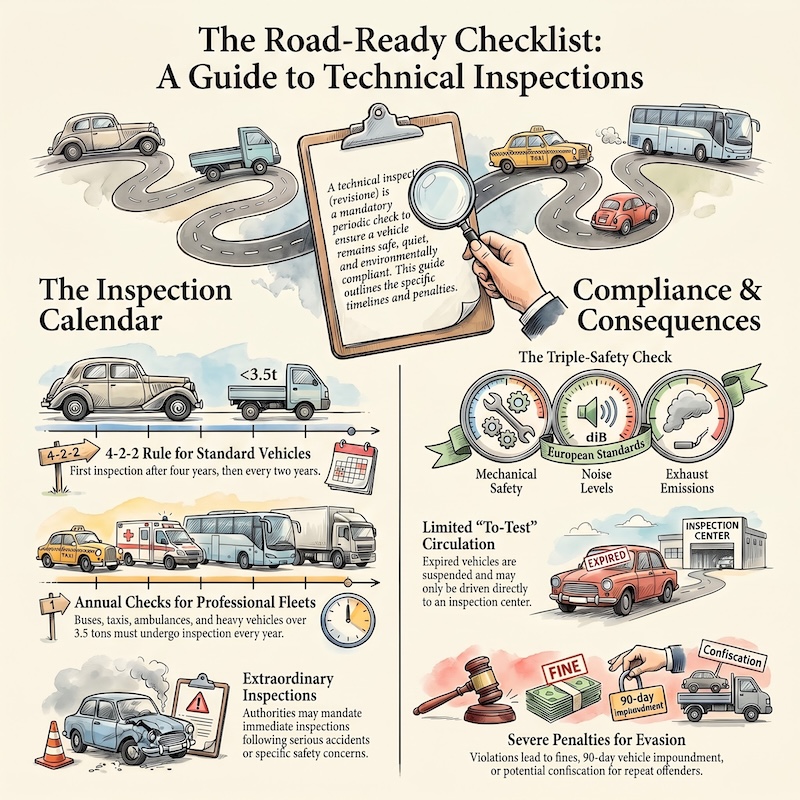
The vehicle inspection is the periodic technical check used to verify whether a vehicle can continue to circulate safely. Its purpose is to confirm that the vehicle and its trailers are still in proper condition from the point of view of safety, that they do not produce excessive noise, and that they do not exceed the legal pollution limits. During this inspection, the devices and parts of the vehicle that are important for road safety are checked, such as brakes, lights, tires, signaling systems, and other equipment.
The technical rules governing inspections are established by the Ministry of Transport and must remain aligned with European rules on technical vehicle inspections. This means that the inspection is not a generic check, but a precise legal procedure based on standards that are also harmonized at European level.
For passenger cars, vehicles used for carrying goods or for special use with a maximum total mass not exceeding 3.5 tonnes, and vehicles for mixed transport, the first inspection must be carried out within four years from the first registration. After the first inspection, it must be repeated every two years. This is one of the most important rules to remember for the theory exam.
For other categories of vehicles, the inspection is annual. This applies to vehicles used for carrying persons with more than nine seats including the driver, vehicles used for carrying goods or for special use with a maximum total mass above 3.5 tonnes, trailers above 3.5 tonnes, taxis, ambulances, vehicles for hire with driver, and atypical vehicles. The yearly frequency is required because these vehicles, due to their use or weight, need more frequent checks.
In addition to ordinary periodic inspections, a special individual inspection may be ordered at any time. This happens when there are doubts about whether the vehicle still meets the required safety, noise, or pollution standards. Such an extraordinary inspection may also be ordered after a report by traffic police. Furthermore, if a vehicle has suffered serious damage in a road accident, the police officers who investigated the accident must report it to the competent office so that a single-vehicle inspection can be considered. This prevents badly damaged vehicles from continuing to circulate without a technical check.
In some cases, in order to make deadlines easier to meet, inspections may also be entrusted to authorized repair shops or qualified businesses, not only to public offices. However, these workshops must meet precise technical, professional, and organizational requirements. They must have suitable equipment, proper premises, and qualified staff. Authorities also carry out periodic checks on these workshops and may randomly check vehicles inspected there. If a workshop no longer meets the requirements or does not follow the rules, its authorization can be withdrawn.
When the inspection is carried out by an authorized workshop, the documents relating to the check and the payment are sent to the competent office so that the result can be recorded on the vehicle registration document. Until that annotation is made, the certificate issued by the workshop temporarily replaces the registration document as proof that the inspection has been completed.
Driving a vehicle that has not undergone the required inspection is a violation. In this case, an administrative fine applies and the registration document is marked to show that the vehicle is suspended from circulation until the inspection is carried out. The vehicle may only be used for the purpose of going to the place where the inspection is to be performed. If it is used normally despite the suspension, much heavier penalties apply, together with administrative detention of the vehicle for ninety days. If the violation is repeated, confiscation of the vehicle may also be ordered.
A false inspection certificate is also considered a very serious matter. If a workshop issues a false certificate, it may lose its authorization. If someone presents a false inspection certificate to the authorities, they are subject to an administrative fine and the withdrawal of the registration document. This shows that the inspection is not just a formality, but an essential control for road safety.
For the theory exam, it is essential to remember that the inspection checks safety, noise levels, and pollution. Private cars and vehicles up to 3.5 tonnes have the first inspection after four years and then every two years, while taxis, buses, ambulances, heavy vehicles, and certain other special vehicles must be inspected every year. A vehicle that has not been inspected cannot circulate freely and may only be used to go for the required inspection.
Studied the theory? Test yourself with 7,000+ official Italian Ministry questions.
📝 Start now with SuperQuizPatente