
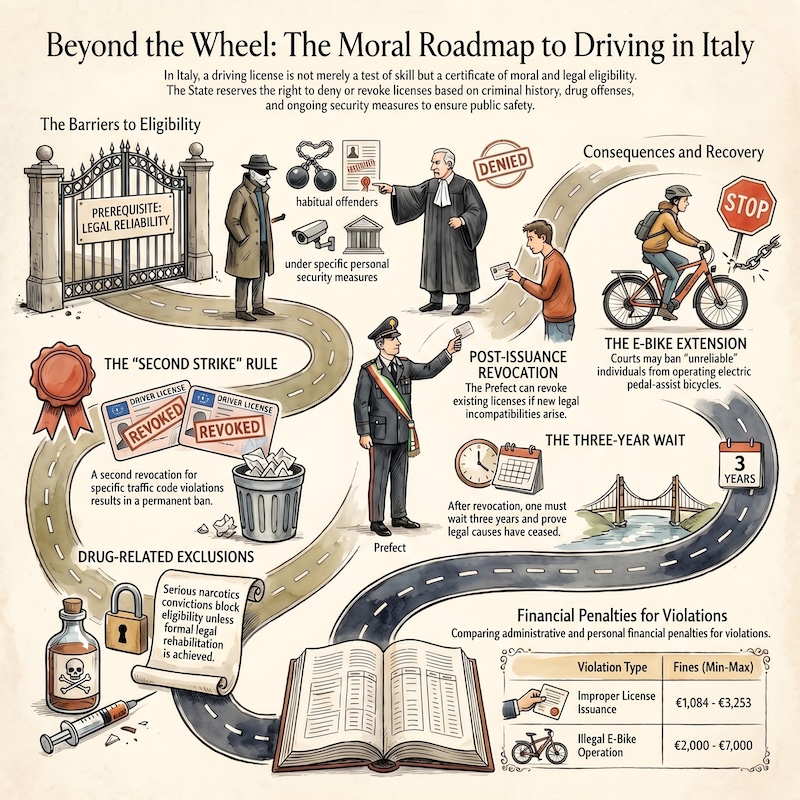
To obtain a driving licence in Italy, it is not enough to pass the test and meet the medical requirements. The law also requires certain personal conditions, meaning legal and individual circumstances that allow the authorities to decide whether a person may be authorized to drive. In some cases, a licence cannot be issued, or it may be revoked even after it has been issued, if situations arise that are considered incompatible with public safety or with the reliability required of a driver.
A licence cannot be obtained by persons considered habitual, professional, or habitual-by-tendency offenders, as well as by persons subject to certain personal security measures or specific preventive measures established by law. In addition, persons convicted of certain serious drug-related offences cannot obtain a licence, unless rehabilitation measures remove the legal obstacle. The law also excludes persons who are subject to specific prohibitions under drug legislation, for the entire duration of those prohibitions. This means that when certain personal or judicial conditions exist, the driving licence cannot be obtained until the obstacle no longer exists.
There is also a case in which a person cannot obtain a new licence again. If a driver has their licence revoked for the second time following a specific conviction provided for by the road code, they cannot obtain a new one under the conditions stated by law. This rule is meant to punish repeated and particularly serious violations more strictly.
If one of these disqualifying conditions arises after the licence has already been issued, the prefect may revoke the licence. In other words, a person who originally met all the requirements may later lose the right to drive if they become involved in situations that the law considers incompatible with holding a licence. However, revocation cannot be ordered without time limits. If more than three years have passed since the preventive measure was applied, or since the conviction for the offences listed by law became final, the licence can no longer be revoked on that basis.
A person whose licence has been revoked in these cases cannot obtain a new licence before at least three years have passed. Even after that period, a new licence may be issued only if the disqualifying conditions no longer exist. Therefore, the mere passage of time is not enough: the personal or legal obstacles that prevented the licence must also have ended.
It is possible to appeal against a refusal to issue the licence or against a revocation order. The appeal is made to the Minister of the Interior, who decides together with the Minister of Infrastructure and Transport within sixty days. This gives the person concerned the possibility to challenge the decision and request a new review.
The law also provides for administrative checks and information exchange between public offices, so that data about disqualifying conditions and revocation measures are transmitted correctly and a licence is not issued to someone who is not entitled to it. In this way, the system verifies whether any obstacle exists before authorizing driving.
Anyone who issues a licence or another driving authorization in violation of these rules, when the act does not amount to a criminal offence, is subject to a high administrative fine ranging from 1,084 to 3,253 euros. This rule is intended to make the responsible offices and officials more accountable as well.
The law also provides an additional measure concerning pedal-assist bicycles, meaning electrically assisted bicycles. For persons falling within the situations described by law, the judge or the prefect may prohibit them from riding these vehicles. This prohibition may accompany a conviction, a security measure, a preventive measure, or the revocation of a driving licence. Rehabilitation measures may remove these effects, while for persons subject to prohibitions under drug legislation the ban lasts for the entire period set by law.
If a person violates the ban on riding pedal-assist bicycles, a very serious administrative sanction applies, ranging from 2,000 to 7,000 euros, together with confiscation of the vehicle. This means that the person must not only pay a substantial fine, but also loses the vehicle used in breach of the prohibition.
In summary, a driving licence depends not only on technical driving ability or health, but also on personal requirements linked to the legal and social reliability of the driver. The purpose of the law is to prevent people involved in particularly serious, dangerous, or incompatible situations from driving or continuing to drive.
Studied the theory? Test yourself with 7,000+ official Italian Ministry questions.
📝 Start now with SuperQuizPatente