
To obtain a driving licence or a learner’s driving authorization, a person must have physical and psychological conditions that are compatible with safe driving. A licence cannot be issued to someone affected by illnesses, impairments, or physical or mental conditions that make it unsafe to drive a motor vehicle. The general principle is clear: a person may drive only if they are able to do so safely without creating danger for themselves or for others.
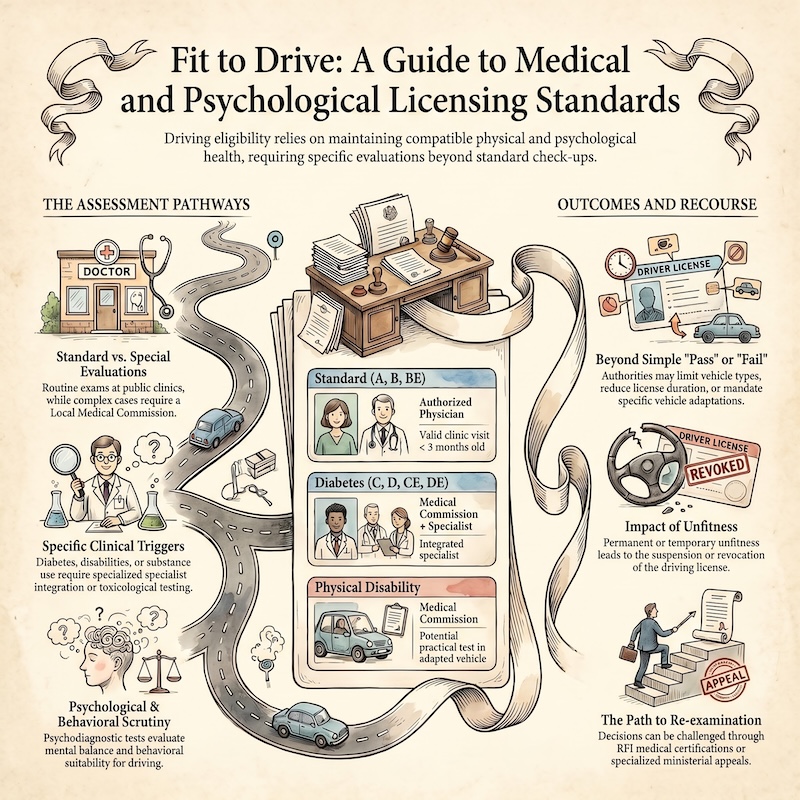
Normally, the assessment of physical and mental fitness is carried out by public health offices with medico-legal functions or by doctors authorized by law. In every case, the medical examination must take place in a medical office. The costs of these examinations are paid by the applicant. The medical certificate used for the driving test application must be recent, meaning it must not be older than three months before the application is submitted. The evaluation must also take into account any previous health conditions declared by the applicant through a certificate issued by their trusted doctor.
In some special cases, an ordinary medical examination is not enough and an assessment by a local medical commission is required. This applies, for example, to persons with physical disabilities or impairments, to people over certain ages who drive particular heavy vehicles, to persons referred by the prefect or by the competent transport office, and to people whose clinical results raise doubts about their fitness to drive safely. Diabetes also has special rules. For categories A, B, BE and related subcategories, fitness is assessed by diabetes specialists, who may also set the date for the next required medical check. For categories C, D, CE, DE and related subcategories, the assessment is carried out by the local medical commission with the participation of a diabetes specialist.
When a person has a physical disability, the decision may require not only a medical visit but also a practical driving test with an adapted vehicle. This is done to verify in practice whether the person can control the vehicle properly using any necessary adaptations. If the disability is stable, not subject to worsening, and does not require changes to the existing restrictions, future licence renewals may then be handled through the ordinary procedure and for the normal legal duration.
For the first issue of any driving licence, or certain professional certificates, the applicant must also show a certificate proving no alcohol abuse and no use of narcotic or psychotropic substances. This certificate is issued on the basis of clinical and toxicological checks. In some cases, the same certificate is also required when renewing or reviewing a driving licence or professional qualification. These costs are also paid by the applicant.
If particular doubts arise during the examination, the doctors or the commission may also require a psychodiagnostic evaluation performed by a qualified psychologist. This assessment is used to examine psychological balance, behavioural suitability, and other factors that may affect driving safety.
If the medical commission considers a person temporarily or permanently unfit to drive, it communicates this decision to the civil motorization office. That office may then suspend or revoke the driving licence. The commission may also shorten the validity period of the licence, limit the types of vehicles the person may drive, or require specific vehicle adaptations. In other words, the result is not always simply fit or unfit: sometimes a person may still drive, but only under precise conditions.
In some situations, if the person obtains at their own expense a new medical certification issued by the peripheral health bodies of Rete Ferroviaria Italiana, the motorization office may review and change the decision. However, this new certificate must be submitted within the time limits allowed for legal appeals; otherwise, that possibility is lost. Suspension or revocation measures adopted because of lack of physical or psychological requirements, in the cases provided by law, are considered final acts.
The law also allows appeals in certain specific cases. For example, in matters concerning persons with physical impairments, the Minister of Transport relies on rehabilitation specialists when deciding on appeals. Local medical commissions may also be joined by different specialists depending on the case, such as rehabilitation doctors, transport engineers, or doctors specialized in alcohol-related conditions. The applicant may also ask for their own trusted doctor to be present.
In summary, obtaining and keeping a driving licence depends on having adequate physical and mental fitness. If there are illnesses, disabilities, or special conditions, the law requires deeper checks, possible limitations, periodic examinations, and in the most serious cases suspension or revocation of the licence. The purpose of all these rules is to ensure that every driver always has the necessary ability to drive safely.
Studied the theory? Test yourself with 7,000+ official Italian Ministry questions.
📝 Start now with SuperQuizPatente