
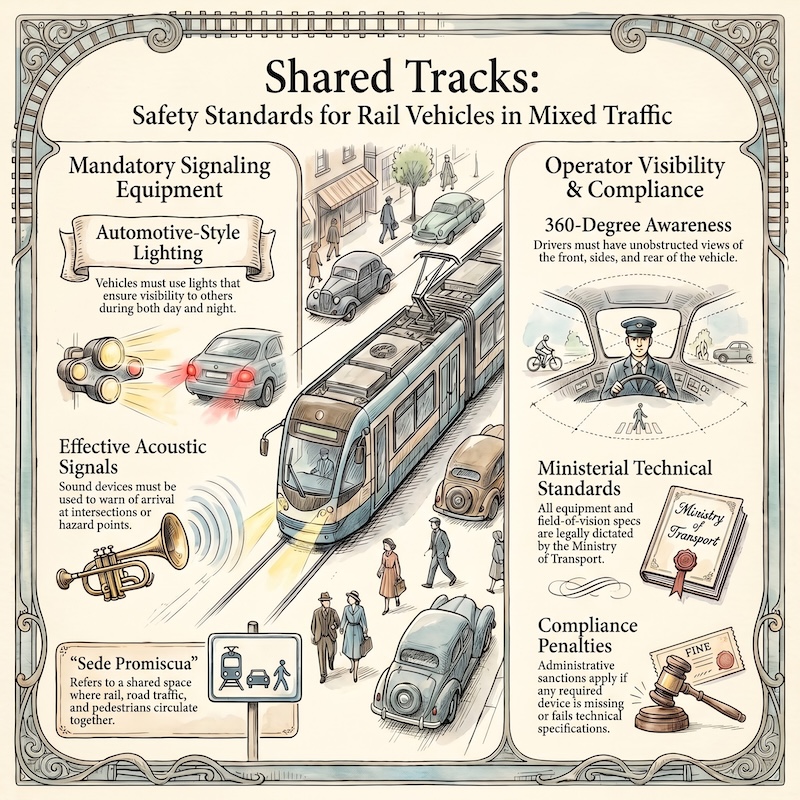
When a rail vehicle travels in mixed traffic, meaning in an area shared with other road users, it must be equipped in a way similar to motor vehicles. This is necessary to ensure safety in an environment where the vehicle does not move in a completely separate space, but shares the road with other vehicles and, in some cases, with pedestrians. For this reason, it must be clearly visible and able to signal its presence effectively.
The vehicle must be fitted with lighting devices and visual and audible warning devices similar to those required for motor vehicles. In practice, it must have lights and signals that allow other road users to notice it easily, both during the day and at night, and it must also be able to warn others of its presence through sound signals when necessary. This is especially important where the track crosses ordinary traffic or where there is a risk that other road users may not notice the vehicle immediately.
In addition to these devices, the vehicle must allow the driver to have good visibility to the rear as well. This means that the driver must be able to monitor not only what is in front and to the sides, but also what is happening behind, so that the vehicle can be driven and maneuvered safely. Forward and side visibility must be wide enough to allow safe driving. In other words, the driver’s field of vision must not be restricted in a way that reduces the ability to notice obstacles, vehicles, pedestrians, or dangerous situations.
The technical characteristics of these devices and the way they must be installed are not left to the choice of the operator, but are established by decree of the Minister of Transport. The required characteristics of the driver’s field of vision are also officially defined. This means that it is not enough simply to have some kind of device: it must meet specific technical standards, be correctly installed, and function in the way required by law.
For theory exam preparation, it is important to remember that rail vehicles operating in mixed traffic must have lighting, visual signaling, and audible warning devices similar to those of motor vehicles, and they must ensure sufficient visibility for the driver to the front, sides, and rear. If even one required device is missing, or if any device or the field of vision does not comply with the technical rules, an administrative fine applies. This shows that, for rail vehicles as well, safety depends both on proper equipment and on the driver’s ability to clearly see the surrounding environment.
Studied the theory? Test yourself with 7,000+ official Italian Ministry questions.
📝 Start now with SuperQuizPatente