
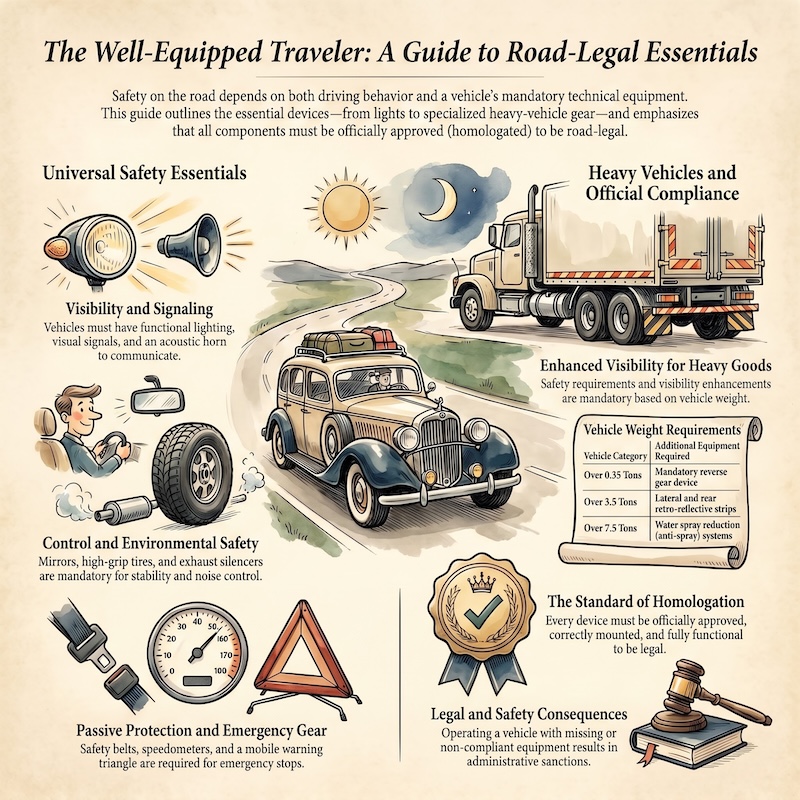
Motor vehicles and their trailers must be equipped with specific devices, because road safety depends not only on driving behavior but also on the mandatory equipment fitted to the vehicle. Mopeds, motorcycles, and motor vehicles must have lighting and visual signaling devices, meaning lights and other elements that allow the driver to see and to be seen. They must also have an audible warning device, such as a horn, rear-view devices to check what is happening behind and to the sides, and tires or equivalent systems that ensure grip and stability. If the vehicle has a combustion engine, it must also be fitted with silencing and exhaust devices, which reduce noise and properly direct exhaust gases.
Motor vehicles and motorcycles with an unladen mass of more than 0.35 tonnes must also have a reversing device. For motor vehicles, the law also requires other specific equipment. This includes restraint and protection devices, such as seat belts and other passive safety systems, when the vehicle was originally designed with the appropriate anchorage points. Motor vehicles must also carry a portable warning sign, meaning the warning triangle used in case of an emergency stop, and an odometer that meets the technical requirements set by the rules.
Some vehicles used for carrying goods are subject to additional obligations. Motor vehicles, trailers, and semi-trailers with a maximum authorized mass above 3.5 tonnes, used for goods transport or for special uses, must be fitted with rear and side reflective strips. These strips make the vehicle more visible at night or in poor visibility, especially when it is long or bulky. Heavier goods vehicles with a maximum authorized mass above 7.5 tonnes must also be equipped with approved devices that reduce water spray in rainy conditions. In practice, these systems reduce the mist and spray raised by the wheels, improving visibility for vehicles following behind.
Motor vehicles may also be fitted with equipment for automatic toll payment, including urban tolls, or systems that receive traffic and road condition information. They may also carry a multifunctional portable emergency signal, according to the rules. This means that, alongside mandatory equipment, some additional devices are allowed when they comply with legal requirements.
Trolleybuses must be equipped, where applicable, with the same devices required for other motor vehicles. Trailers, on the other hand, must at least have visual signaling and lighting devices, as well as tires or equivalent systems. Both vehicles approved for towing trailers and the trailers themselves must also have suitable coupling devices, meaning safe and proper systems for connecting the trailer to the towing vehicle.
There are also special rules for vehicles intended for particular uses. The Minister of Transport may require additional devices, either mandatory or optional, depending on the vehicle’s purpose, its special use, or specific driving rules. Specific provisions also exist for vehicles intended to be driven by persons with disabilities or used for their transport, so that they can be adapted to particular driving and safety needs.
The equipment devices required by law must be type-approved. This means they must be officially approved and comply with the established technical requirements. The rules define not only which devices must be present, but also their number, construction features, how they must be installed, and the marking that proves their conformity. In some cases, an approval granted by a foreign state may also be recognized as valid in Italy, provided there is reciprocity and international agreements are respected.
For the theory exam, it is important to remember that a vehicle must have all the required devices, they must work properly, and they must comply with the rules. It is not enough for an accessory simply to be present: it must also be of the correct type, correctly installed, and, when required, approved. Anyone driving a vehicle that lacks even one mandatory device, or has equipment that does not comply with the legal standards, is subject to an administrative fine. In other words, vehicle equipment is an essential part of road safety and lawful circulation.
Studied the theory? Test yourself with 7,000+ official Italian Ministry questions.
📝 Start now with SuperQuizPatente