Road markings are lines and symbols painted directly on the road surface. They regulate traffic, guide drivers, and indicate correct behavior while driving. They are essential because they help drivers understand how to position their vehicle and act in different situations.
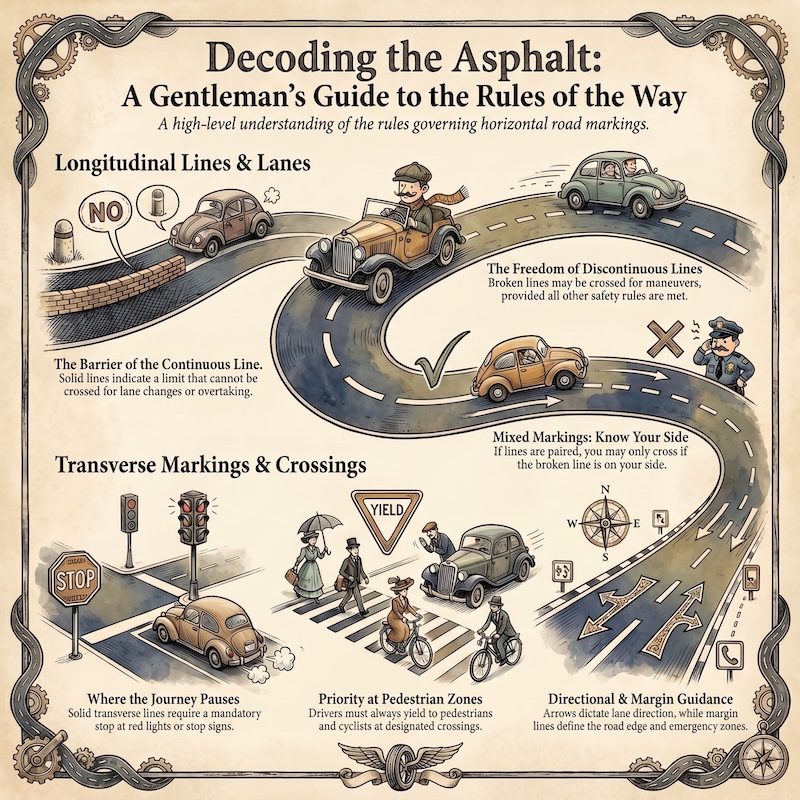
Longitudinal lines divide lanes or mark the edges of the carriageway. Continuous lines indicate a boundary that must not be crossed, meaning overtaking or changing lanes is prohibited. Broken lines can be crossed, but only when it is safe and all other traffic rules are respected. If a continuous line is paired with a broken one, it may only be crossed from the side of the broken line.
Transverse lines are placed across the road and indicate where a driver must stop. A continuous line means a mandatory stop, such as at a red light, stop sign, or when instructed by a traffic officer. A broken line indicates that the driver must stop only if necessary, such as when giving way.
Pedestrian and cycle crossings mark where pedestrians and cyclists may cross the road. Drivers must always give way to those who are crossing or about to cross. These crossings must also be accessible to people with disabilities and may include additional markings for visually impaired persons.
Directional arrows show the direction vehicles must follow in each lane, while symbols and road markings provide additional information, such as speed limits or reserved lanes.
Parking markings indicate where vehicles may stop or park, including reserved spaces for specific users. Traffic islands are used to separate traffic flows or indicate obstacles within the road.
Edge lines mark the limits of the carriageway and may only be crossed in special cases, such as emergencies or by authorized vehicles. In general, it is prohibited to park on roads with continuous edge lines, drive along road markings unnecessarily, or use reserved lanes without permission.
For the theory exam, it is important to remember that continuous lines must not be crossed, while broken lines can be crossed with caution. Understanding stop lines and correct behavior at crossings is also essential.
Studied the theory? Test yourself with 7,000+ official Italian Ministry questions.
📝 Start now with SuperQuizPatente