
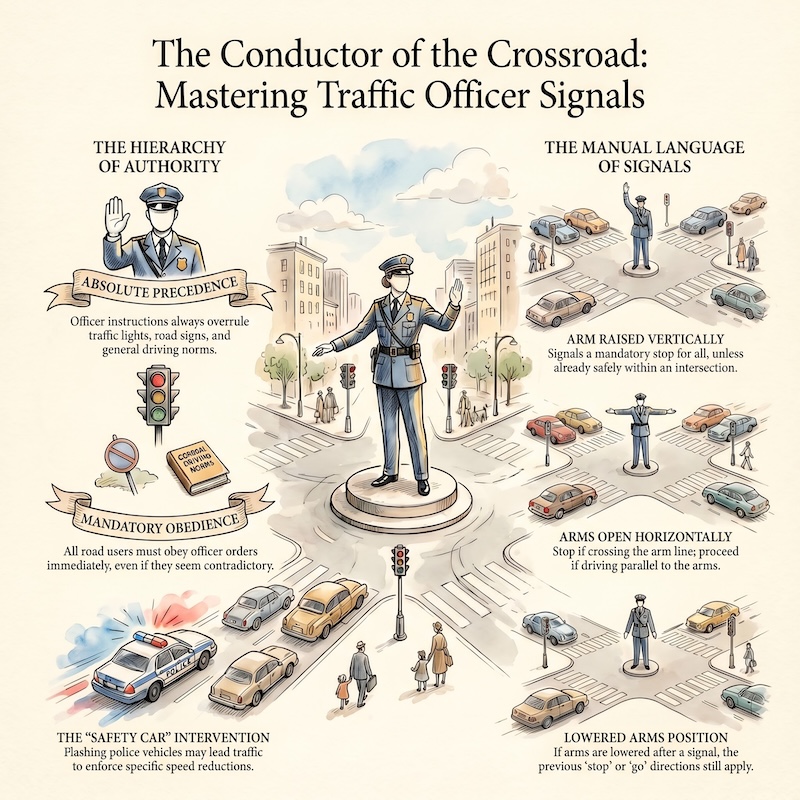
Traffic officer signals have absolute priority over all other traffic rules. All road users must immediately obey their instructions, even if they conflict with traffic signs, traffic lights, or general rules. This means that when an officer is present, their signals always override any other indication.
When an officer raises one arm vertically, it means that all vehicles must stop. However, drivers who are too close to stop safely may continue. If this signal is given at an intersection, vehicles that have already entered it may proceed.
When the officer extends one or both arms horizontally, it means stop for vehicles coming from directions that cross the line of the arms. Vehicles moving in the same direction as the arms are allowed to proceed.
If the officer lowers the arms after these signals, the meaning remains the same: vehicles in front of or behind the officer must stop, while those to the sides may continue.
Officers may also give other instructions depending on the situation, such as ordering vehicles to slow down, speed up, stop, or change direction. These instructions must always be followed, even if they contradict existing signs or rules.
In some cases, especially on roads with separated carriageways, traffic may be controlled by police vehicles moving ahead of traffic to slow it down. These vehicles use flashing lights and display a “safety car” sign.
For the theory exam, it is essential to remember that officer signals always take priority and that understanding their meaning is crucial for safe driving.
Studied the theory? Test yourself with 7,000+ official Italian Ministry questions.
📝 Start now with SuperQuizPatente