
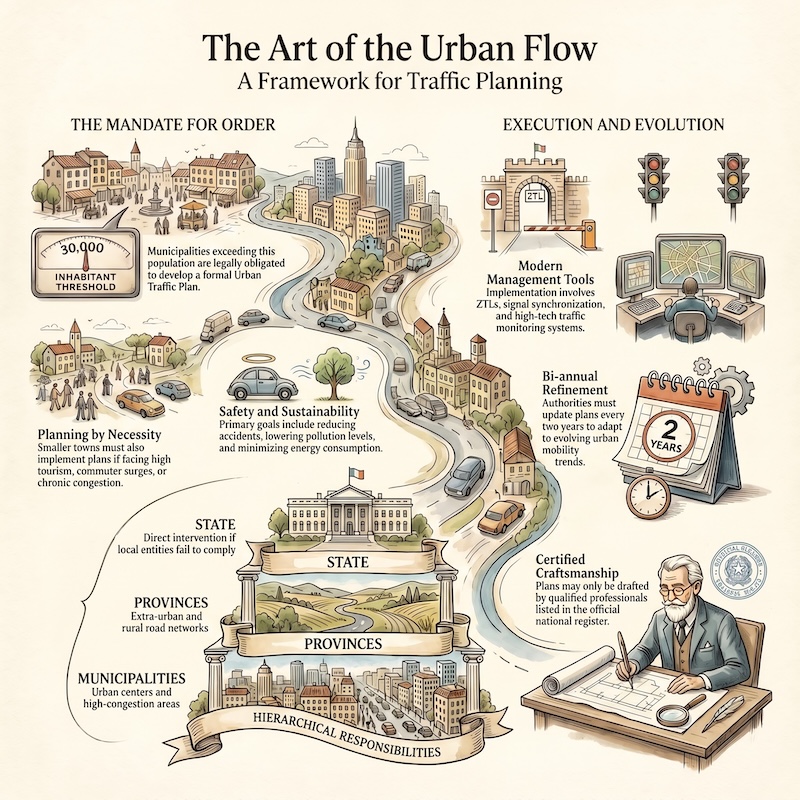
Municipalities must organize traffic through structured planning tools known as traffic plans. Cities with more than thirty thousand inhabitants are required to adopt an urban traffic plan, while smaller municipalities must do so when they face significant issues such as heavy tourism, high levels of daily commuting, or serious traffic congestion. In these cases, the obligation is defined at the regional level and officially recognized.
For roads outside urban areas, provinces are responsible for preparing traffic plans for extra-urban mobility, working together with other road authorities. In metropolitan areas, specific governing bodies may be responsible for urban traffic planning.
The main goal of these plans is to improve traffic flow and increase road safety, while also reducing pollution and energy consumption. This is achieved through planned and coordinated measures that are consistent with urban development and transport strategies. Examples include introducing one-way streets, restricted traffic zones, traffic light coordination, or speed control systems.
Traffic plans also rely on modern technologies, such as computerized systems to monitor traffic, manage vehicle flows, and control speed in critical areas. These tools allow traffic to be adapted to real conditions, improving both efficiency and safety.
Urban traffic plans must be updated every two years, as traffic conditions change over time. Local authorities are required to communicate updates to the Ministry, which collects and manages this information at a national level.
The preparation of these plans must follow national guidelines and consider environmental and territorial planning policies. To ensure quality, there is an official register of experts, and plans must be prepared by qualified technicians or certified professionals.
If a municipality or authority fails to fulfill these obligations, the State may intervene and implement the plan directly, ensuring proper traffic management.
Studied the theory? Test yourself with 7,000+ official Italian Ministry questions.
📝 Start now with SuperQuizPatente