
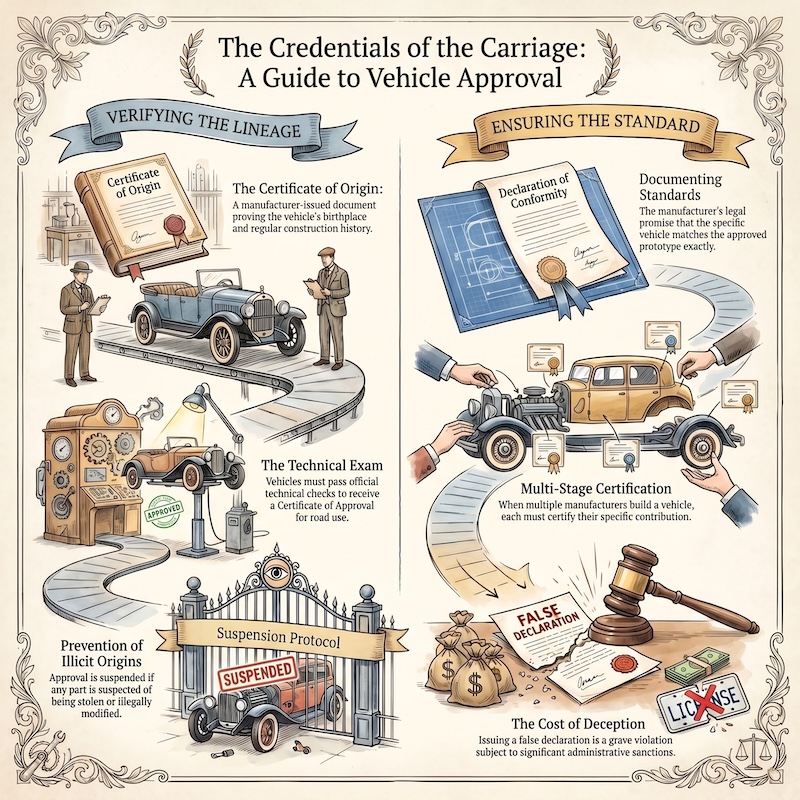
When a vehicle successfully passes the technical inspections required to verify its roadworthiness, the competent authority issues an approval certificate to the manufacturer. This document officially confirms that the vehicle has been examined and complies with the technical and safety requirements established by law.
To request this inspection, the certificate of origin issued by the manufacturer must also be provided. This document proves where the vehicle comes from and that it has been properly built. However, for vehicles already type-approved in a European Union member state, the certificate of origin can be replaced by a declaration of conformity. This declaration confirms that the vehicle matches an already approved and recognized type.
If, during the inspection, there are doubts about the origin of the vehicle or any of its parts, for example if there is suspicion of illegal origin, the issuance of the approval certificate is suspended until further checks are completed. This prevents stolen or illegally modified vehicles from entering circulation.
For vehicles produced in series, once the prototype has been approved, a type-approval certificate is issued to the manufacturer. Along with this certificate, a technical description of the vehicle is provided, defining its main characteristics. Every vehicle produced afterward must correspond exactly to the approved model.
For each vehicle built according to the approved type, the manufacturer must provide the buyer with a declaration of conformity. This document is very important because it certifies that the purchased vehicle matches the approved model. The manufacturer is legally responsible for this declaration and must keep a record of all issued declarations.
If a vehicle is assembled or modified by different manufacturers, each one must certify the part under their responsibility. In such cases, the final documentation consists of multiple certificates that together confirm that all parts comply with the regulations. This is typical for vehicles built in multiple stages.
It is important to understand that issuing a declaration of conformity for a vehicle that does not actually match the approved type is a serious violation. Anyone who issues a false declaration is subject to significant administrative penalties. This ensures that the documentation is reliable and that vehicles on the road truly meet the required standards.
For the theory exam, it is essential to remember that every vehicle must be accompanied by documents proving its origin and compliance with regulations. The approval certificate, certificate of origin, and declaration of conformity are key documents that confirm a vehicle is legal, safe, and fit for circulation.
Studied the theory? Test yourself with 7,000+ official Italian Ministry questions.
📝 Start now with SuperQuizPatente