
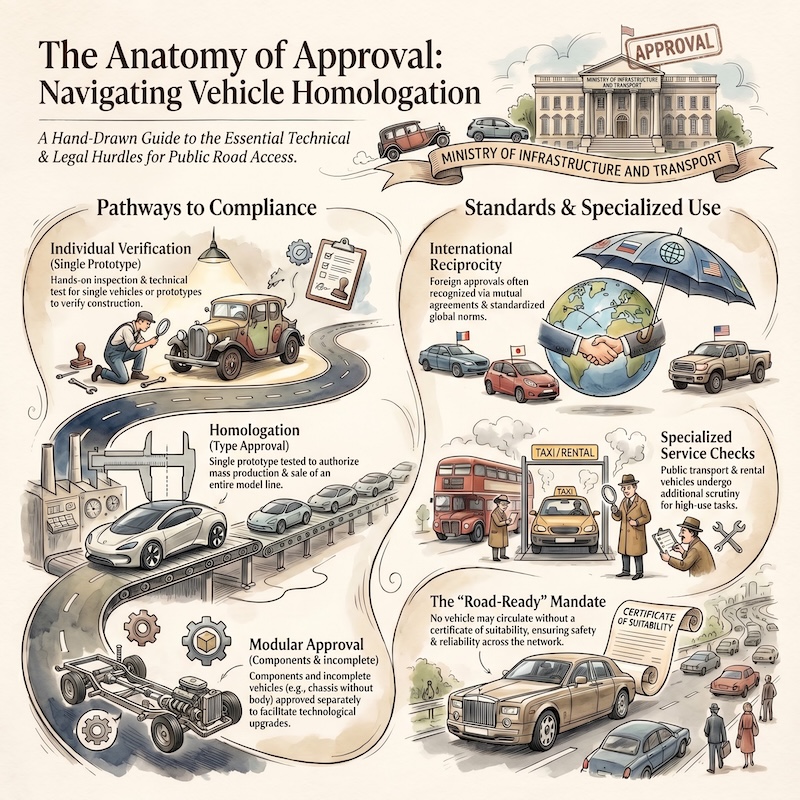
In order to be allowed on the road, all vehicles such as mopeds, motorcycles, motor vehicles, trolleybuses, and trailers must undergo an official inspection to verify that they meet legal requirements. This inspection checks both the vehicle’s identification data and its compliance with the technical and construction standards established by law. In practice, before a vehicle can circulate, it must prove that it has been correctly built and meets the required safety and performance standards.
In the case of mopeds derived from a bicycle with a small auxiliary engine, the inspection is limited to the engine, since the rest of the vehicle already follows the characteristics of a standard bicycle.
The inspection may apply to a single vehicle or to multiple vehicles of the same type. It is carried out through technical examination and testing by the competent offices of the Ministry of Infrastructure and Transport. During this process, both the vehicle’s characteristics and the submitted documentation are checked. The exact procedures and required documents are defined by official decrees.
When vehicles are mass-produced, it is not necessary to inspect each individual unit from the beginning. In these cases, type approval is applied. This means that a prototype of the vehicle is tested, and if it meets the requirements, all vehicles of the same model can be produced and placed on the market under that approval. Type approval ensures that all vehicles in the same series comply with the required standards.
There are also specific rules for the approval and installation of individual components or systems. These can be used as replacement parts or as additions to new or already circulating vehicles. When such components are approved according to national standards, it is often not necessary to obtain authorization from the vehicle manufacturer, unless otherwise specified. This makes it easier, for example, to install new technological or safety devices.
The rules for approval often follow European or international standards, ensuring consistency across different countries. The relevant inspections are always carried out by the competent authorities of the Ministry of Transport.
Some vehicles intended for specific services, such as hire with driver, public transport, or scheduled passenger transport, may be subject to additional checks to verify their suitability for the intended use.
Approval granted by a foreign country may also be recognized as valid in Italy, provided there is reciprocity and international agreements are respected. It is also possible to obtain approval for incomplete vehicles, such as those without a body. In such cases, a further inspection is required once the vehicle is completed.
For the theory exam, it is important to understand that no vehicle can circulate without being inspected and declared suitable. Approval ensures that manufactured vehicles meet technical standards, while individual inspections ensure that each vehicle in use complies with the rules. This system guarantees safety, reliability, and proper regulation of road traffic.
Studied the theory? Test yourself with 7,000+ official Italian Ministry questions.
📝 Start now with SuperQuizPatente