
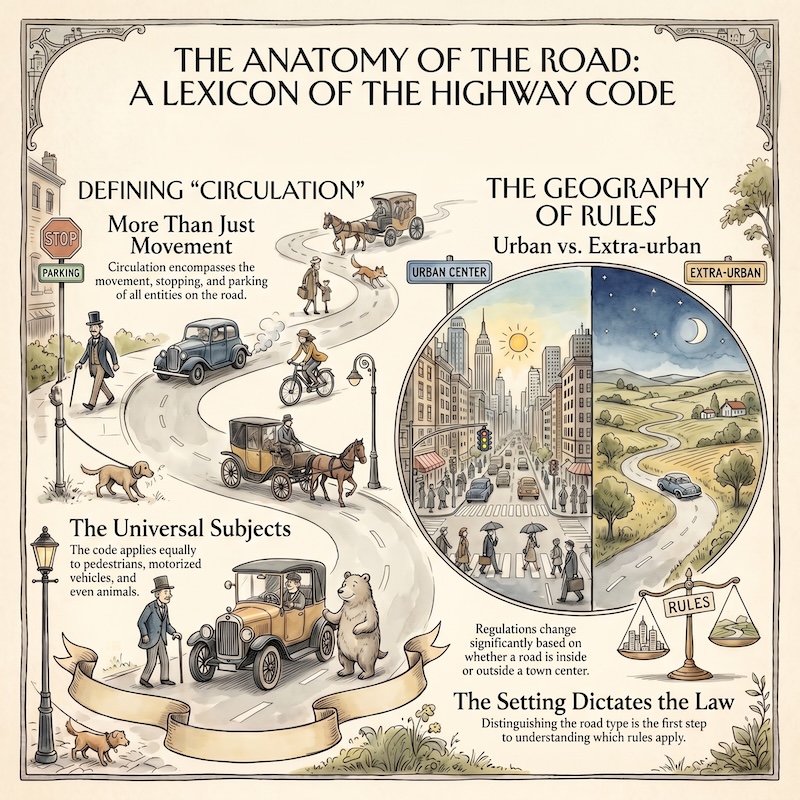
To study the Highway Code well, it is important to understand the exact meaning of the main road and traffic terms. Traffic includes not only the movement of vehicles, but also the stopping and parking of pedestrians, vehicles, and animals on the road. A road may be inside or outside a built-up area, and this distinction is important because many rules change depending on whether the road is urban or extra-urban.
The carriageway is the part of the road used for vehicle movement. Inside it there may be one or more lanes, meaning longitudinal spaces that allow one line of vehicles to pass. There are normal traffic lanes, reserved lanes for specific categories of vehicles, acceleration lanes used to enter a carriageway without disturbing traffic, deceleration lanes used to leave safely, and emergency lanes used for emergency stops and rescue vehicles. In some cases there are also cycle lanes, intended to make bicycle travel easier, including lanes that allow cyclists to move in the opposite direction to the one-way direction allowed for other vehicles.
The shoulder is the part of the road next to the carriageway. The sidewalk, on the other hand, is the raised or protected part reserved for pedestrians. If there is no sidewalk, there may be a pedestrian passage separated from the carriageway and intended for pedestrians. A pedestrian crossing is the marked part of the carriageway where pedestrians have priority when crossing from one side of the road to the other. A refuge island is a protected area where pedestrians can stop safely, for example in the middle of the road or near public transport stops.
An intersection is the area where two or more roads meet. It can be at the same level or grade-separated, such as junctions with ramps, underpasses, or overpasses. At an intersection, different traffic flows meet, meaning groups of vehicles or pedestrians moving in the same direction. To organize these movements better, elements such as channelization, channelizing islands, and lane selection areas are used to help vehicles position themselves correctly before turning or crossing.
A median is the non-drivable part that separates different traffic flows. The road boundary marks the limit of the road property. The road area includes the entire surface within these boundaries, so not only the carriageway but also the side areas belonging to the road. The roadside strip is part of the road property, while the setback strip lies outside the boundary and is subject to special restrictions, for example for buildings or planting.
A curve connects two straight sections and may reduce visibility. A crest is a convex section of road, while a dip is a concave section. These elements are important because they affect visibility and therefore driving safety. The ditch may also refer to the roadside structure designed to collect and drain rainwater.
Areas intended for stopping and parking have different meanings. A parking area is a space outside the carriageway intended for vehicle parking. A park-and-ride parking area is located near stations or public transport stops and helps drivers switch from a car to public transport. A lay-by is a small side area where vehicles can stop. A lateral parking strip is an area next to the carriageway with parking spaces and a maneuvering lane. A bus bay is the space reserved for public transport stops.
A cycle track is a part of the road reserved for bicycles. A pedestrian and cycle route is mainly intended for pedestrians and cyclists and is meant to protect users who are more exposed to traffic dangers. Vulnerable road users include pedestrians, persons with disabilities, cyclists, moped riders, motorcyclists, and, more generally, anyone who deserves special protection.
Pedestrian areas are zones where vehicles are normally not allowed, except for certain cases provided by law, such as emergency vehicles, bicycles, and vehicles serving persons with reduced mobility. A limited traffic zone is an area where vehicle access is allowed only at certain times or only for specific categories of users and vehicles. There are also cycle zones, where rules give priority to bicycles, residential zones, where special protection is given to pedestrians and the environment, and school zones, which are near schools and provide greater protection for pedestrians and the environment.
A built-up area is a continuous group of buildings marked by specific start and end signs. Understanding whether a road is inside or outside a built-up area is essential because it affects speed limits, priority rules, signals, and other driving rules. A rural public-use private road is a private road outside built-up areas that is open to public use, while a path is a natural track created by the passage of pedestrians or animals.
Other important terms concern traffic organization. A waiting area is the section before the stop line where vehicles wait for permission to proceed, often divided into lanes according to the intended direction. A bicycle waiting area is a similar space reserved for bicycles. An exchange area is a section where vehicles traveling in the same direction can change position without stopping. Knowing these terms helps in understanding road signs, road layout, and the behavior required while driving.
Studied the theory? Test yourself with 7,000+ official Italian Ministry questions.
📝 Start now with SuperQuizPatente