
A road is any public area used for the movement of pedestrians, vehicles, and animals. All road users must follow the rules to ensure safety and proper traffic flow.
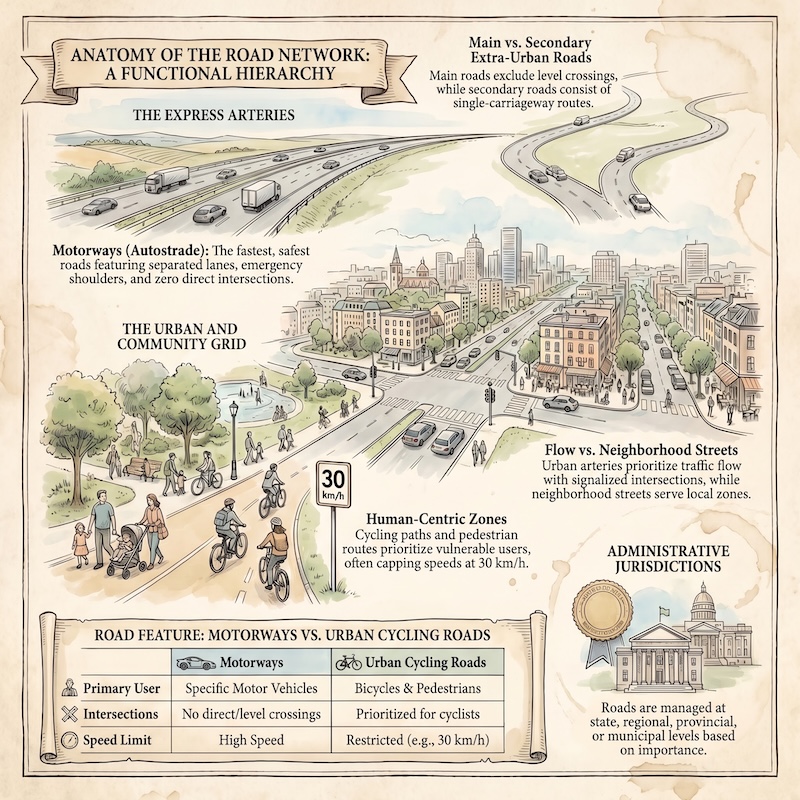
Roads are divided into different categories based on their structure and function. The main types are motorways, main extra-urban roads, secondary extra-urban roads, urban main roads, urban local roads, urban cycling roads, local roads, and pedestrian-cyclist routes.
Motorways are the fastest and safest roads, with separated carriageways, at least two lanes in each direction, emergency lanes, and no direct intersections. They are reserved for certain motor vehicles and include service and rest areas.
Main extra-urban roads are similar to motorways but slightly less strict. Traffic is mainly for motor vehicles and there are no level intersections.
Secondary extra-urban roads have a single carriageway with at least one lane in each direction and are less structured.
In urban areas, main urban roads are designed to support fast traffic, with multiple lanes, traffic lights at intersections, and separate parking areas. Urban local roads serve neighborhoods, with slower traffic, parking spaces, and sidewalks.
Urban cycling roads have a reduced speed limit, usually up to 30 km/h, and give priority to bicycles. Pedestrian and cycling routes are mainly intended for pedestrians and cyclists, offering higher safety for vulnerable users.
Local roads include all roads not part of the main categories and are used for local connections, both in urban and rural areas.
There are also service roads, which run alongside main roads and allow access, parking, and vehicle movements without interfering with fast traffic.
From an administrative perspective, roads can be state, regional, provincial, or municipal, depending on their importance and management. Urban roads are generally municipal.
Road classifications can change over time if their function changes. All classified roads are recorded in a national registry.
Studied the theory? Test yourself with 7,000+ official Italian Ministry questions.
📝 Start now with SuperQuizPatente