
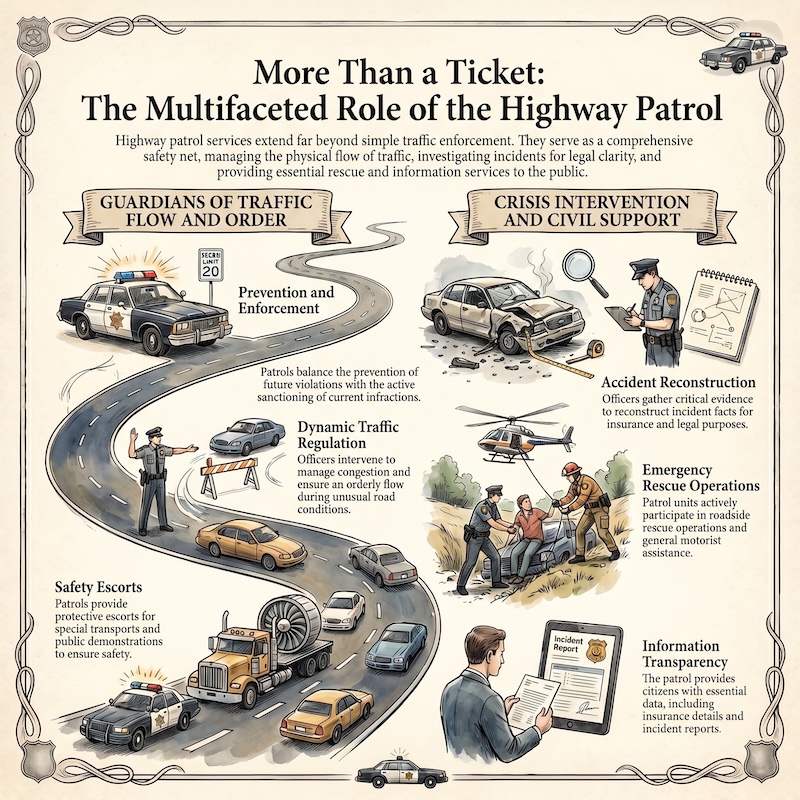
Road police services include all activities necessary to guarantee safety, order, and control over road traffic. These include the prevention of Highway Code violations and the detection of offenses that have already been committed. This means that road police do not act only to punish unlawful behavior, but also to prevent it and reduce risks for road users.
Another fundamental function is the recording of road accidents. When an accident occurs, road police authorities collect the information needed to reconstruct the event, determine the circumstances, and identify the vehicles and persons involved. This activity is important both for safety reasons and for insurance or legal matters.
Road police also carry out services aimed at regulating traffic. In practice, they may intervene to manage circulation, handle congestion, facilitate passage in particular situations, and ensure a safer and more orderly traffic flow.
Their tasks also include escort services for traffic safety. This may be necessary, for example, in the case of special transport, public events, or other situations in which road users need protection and traffic must be kept safe.
Road police are also responsible for protecting and supervising the proper use of the road. This means ensuring that roads are used correctly and in compliance with the rules, and intervening when behavior or situations may put safety at risk.
In addition to these tasks, road police authorities take part in roadside and vehicle assistance operations in general. They may also collaborate in traffic surveys and studies, which are useful for understanding traffic problems better and improving mobility planning.
In general, road police services are coordinated by the Ministry of the Interior, while in built-up areas the powers assigned to municipalities remain in place. This ensures a uniform organization of checks and interventions throughout the territory.
Interested persons may ask the road police for information collected in relation to an accident, such as how it occurred, the residence and domicile of the parties involved, the insurance coverage of the vehicles, and the identifying data of those vehicles. This information may be useful, for example, for insurance claims or for protecting one’s rights after an accident.
Studied the theory? Test yourself with 7,000+ official Italian Ministry questions.
📝 Start now with SuperQuizPatente