
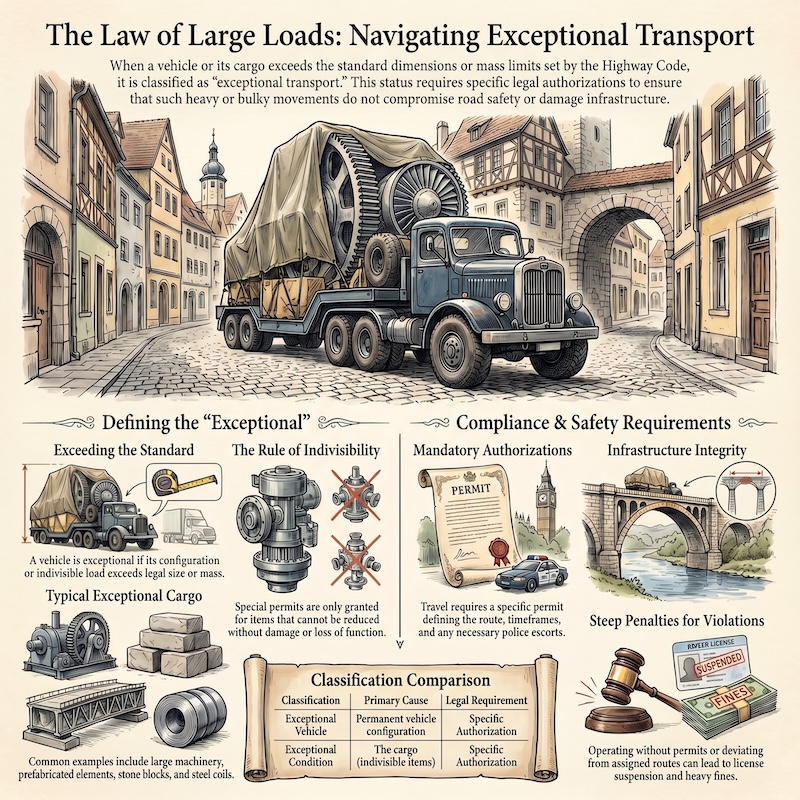
A vehicle is considered exceptional when, in its normal driving configuration, it exceeds the legal limits of size or mass established by the Highway Code because of specific functional needs. Transport is considered exceptional when it is the load that causes these limits to be exceeded, for example because indivisible goods are too long, wide, high, or heavy to remain within ordinary limits.
Indivisible goods are items that cannot be reduced in size or weight without being damaged, without losing their function, or without making transport unsafe. For this reason, the law allows oversized or overweight transport in specific cases, but only under strict conditions and with special precautions.
Exceptional transport includes, for example, loads that project too far to the rear or front, transport of large machines, prefabricated elements, stone blocks, steel coils, special containers, bales of straw or hay, live animals on variable-height vehicles, and the transport of agricultural or operating machinery. Some work vehicles may also fall under this regime when they exceed ordinary mass limits.
As a general rule, exceptional vehicles and exceptional transport may circulate only with a specific authorization issued by the competent authority. The authorization may be valid for one journey, several journeys, or a certain period of time. It may specify the compulsory route, time limits, safety requirements, and, when needed, the obligation to use a technical escort or police escort.
Authorization is granted only if the transport is compatible with road safety, with the resistance of the road, and with the stability of bridges, viaducts, and other structures. In some cases the transport causes greater wear to the road, and then compensation is owed to the road authority. Payment may also be required for technical checks, traffic organization, and any works needed to allow the passage.
There are some special cases in which authorization is not required, but only if certain limits are respected and the operator verifies that the chosen route is suitable. This applies, for example, to some vehicles used for carrying other vehicles, containers, live animals, straw, hay, or machinery when they do not exceed certain thresholds. Work vehicles may also circulate without authorization in specific cases, but only within precise mass limits and only on suitable roads.
Work vehicles have their own special rules. They may exceed ordinary mass limits up to the values established by law, but only if they comply with precise conditions, such as traveling only on permitted roads, respecting posted restrictions, and paying the wear compensation charge. If these conditions are not respected, they too must obtain the normal authorization required for exceptional transport.
The authorization must always be carried during the journey. Anyone who circulates without obtaining it, or violates even one essential condition stated in it, such as the route, period, mass or size limits, or escort obligation, is subject to significant administrative penalties. Penalties also apply when the authorization exists but is not carried on board the vehicle.
If the prescribed conditions are violated, the journey cannot continue until the transport or vehicle has been regularized. In more serious cases, the officer may order the trip to stop immediately, may immobilize the vehicle, and may withdraw the documents. In addition to the financial penalty, accessory sanctions may also apply, such as suspension of the driving licence and the registration document.
Anyone who improperly uses a work vehicle to carry goods different from those allowed, or drives it on prohibited roads or with excessive mass, is subject to very serious sanctions. In cases of repeated violations, the vehicle may also lose its status as a work vehicle.
In summary, exceptional vehicles and exceptional transport may circulate only under strict conditions because their weight or dimensions may endanger road safety and damage infrastructure. For the theory exam, the key point to remember is this: when a vehicle or its load exceeds normal limits, special rules, specific authorization, and full compliance with all prescribed conditions are required.
Studied the theory? Test yourself with 7,000+ official Italian Ministry questions.
📝 Start now with SuperQuizPatente