
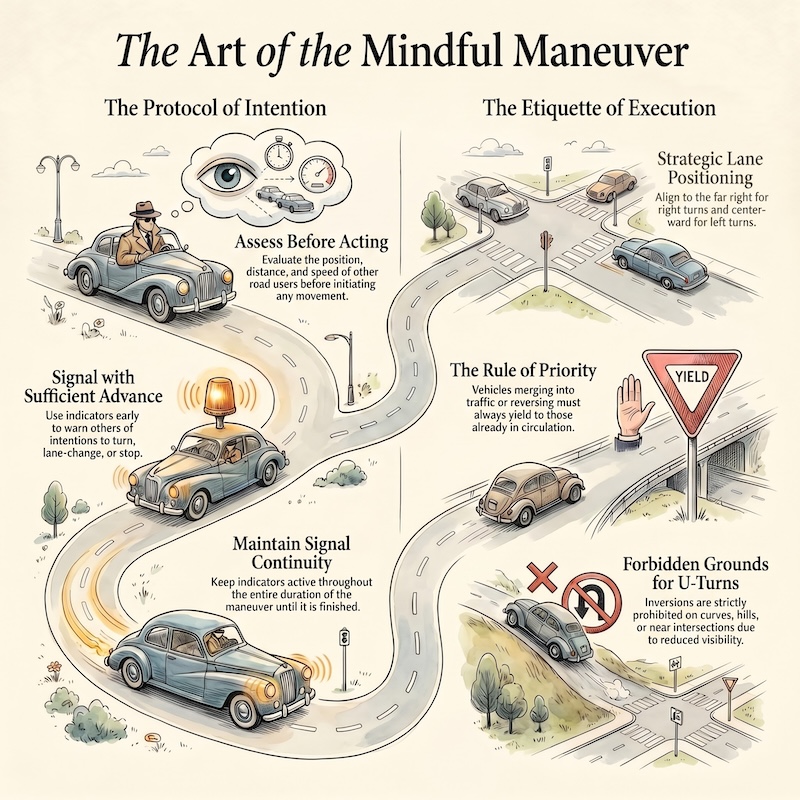
When a driver intends to perform a maneuver, such as entering traffic, changing lanes, turning, reversing, making a U-turn, or stopping, they must act with maximum caution. Before starting the maneuver, it is mandatory to ensure that it can be carried out without creating danger or obstruction to other road users, carefully considering their position, distance, and speed. The intention must also be signaled in advance.
Signals must be given using the vehicle’s direction indicators and must remain active throughout the entire maneuver until it is completed. The same indicators must also be used to signal the intention to slow down and stop. If the vehicle does not have indicators, hand signals must be used.
During turns, it is important to maintain the correct position on the road. To turn right, the driver should keep as close as possible to the right edge of the roadway, while to turn left, the driver should move toward the center of the road or the left edge in one-way streets. The turn must be executed without entering the opposite lane and with great attention to other road users.
When reversing or entering traffic, the driver must always give way to vehicles already in motion. Sudden maneuvers, such as abrupt braking or unexpected slowing down, must be avoided as they can create dangerous situations.
U-turns are prohibited near or at intersections, curves, and hilltops, where visibility is limited and the risk of accidents is higher.
Improper use of direction indicators is also prohibited. Respecting these rules is essential to ensure smooth and safe traffic flow. Violations result in administrative fines and, in serious cases, may affect the driving license.
Studied the theory? Test yourself with 7,000+ official Italian Ministry questions.
📝 Start now with SuperQuizPatente