
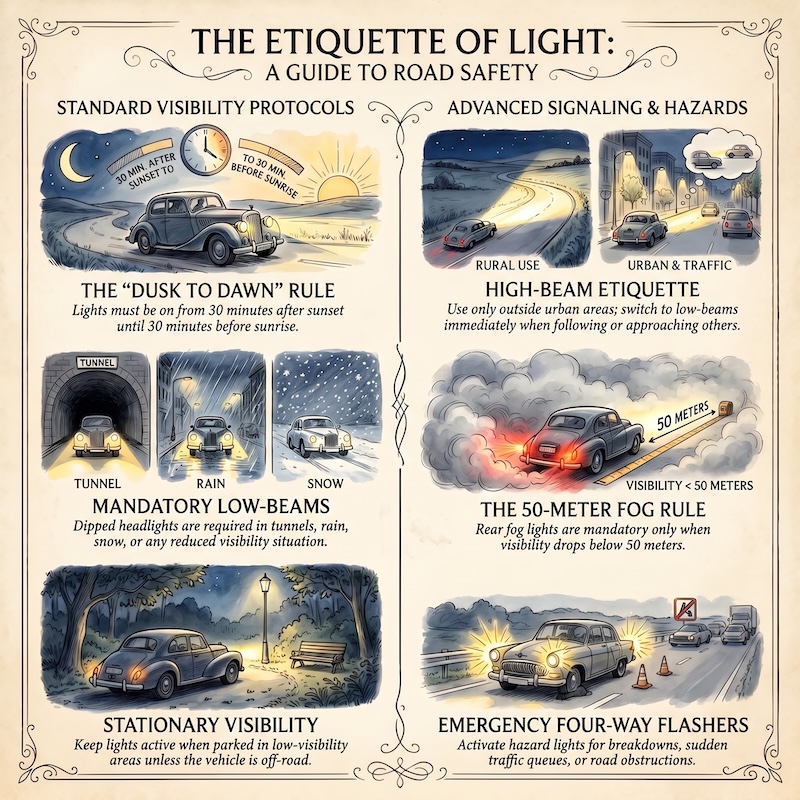
The correct use of lighting and signaling devices is essential for road safety, especially in poor visibility conditions. During nighttime, defined as from half an hour after sunset to half an hour before sunrise, and also during the day in tunnels, fog, heavy rain, snow, or any situation with reduced visibility, vehicles must use position lights, number plate lights, and, if required, clearance lights. Motor vehicles must also use dipped headlights.
High beam headlights may only be used outside built-up areas when public lighting is absent or insufficient. However, they must always be switched to dipped headlights when approaching other vehicles, following another vehicle at close distance, or whenever there is a risk of dazzling other road users. High beams may be used briefly to signal danger or the intention to overtake.
In fog, heavy rain, or snowfall, front fog lights may be used as an alternative to dipped headlights. Additionally, when visibility drops below 50 meters, rear fog lights must be used if the vehicle is equipped with them.
When a vehicle is stopped or parked in low visibility conditions, the lights must remain on unless the vehicle is clearly visible due to street lighting or is parked off the roadway. In built-up areas, smaller vehicles may use parking lights instead of position lights.
Hazard warning lights must be activated in dangerous situations, such as breakdowns, sudden slowdowns, traffic jams, obstruction of the road, or emergency stops.
The use of unauthorized lighting devices is prohibited. Improper use of lights results in administrative fines. For the theory exam, it is important to understand when each type of light must be used, as these rules are designed to prevent dazzling and ensure visibility for all road users.
Studied the theory? Test yourself with 7,000+ official Italian Ministry questions.
📝 Start now with SuperQuizPatente