
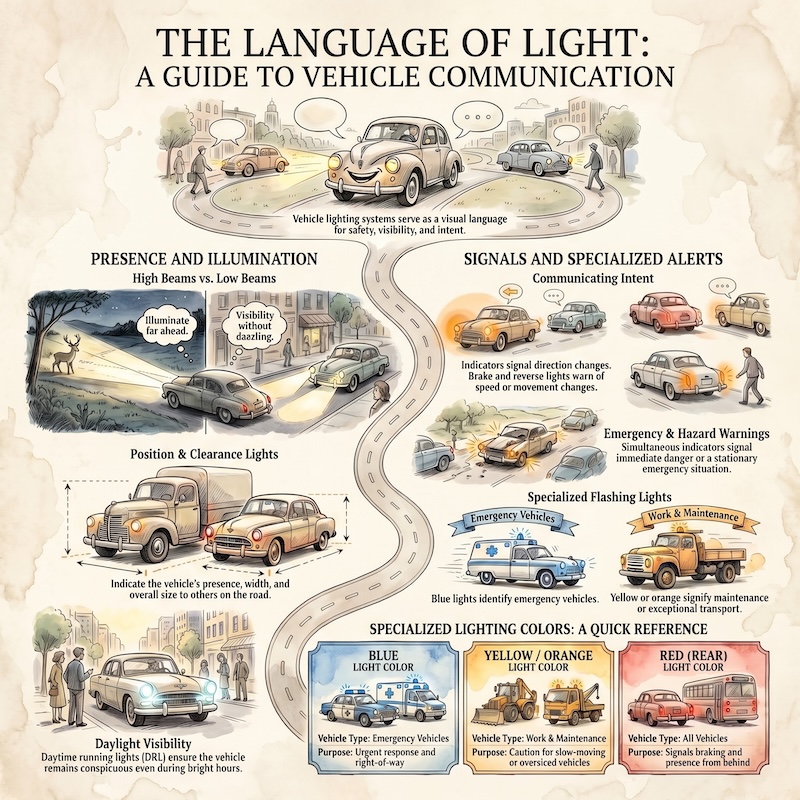
Vehicle lights and signaling devices have the essential purpose of ensuring visibility and communication between road users. They allow drivers to see the road, to be seen, and to signal their intentions to others.
The main headlights are of two types. The high beam (main beam) illuminates the road far ahead but can dazzle other drivers. The low beam (dipped beam) illuminates the road without dazzling others and is the most commonly used during normal driving.
In poor visibility conditions such as fog, heavy rain, or snow, front fog lights are used to improve road visibility. At the rear, the fog light helps make the vehicle more visible to others.
The reversing light has a double function: it illuminates the area behind the vehicle and signals to others that the vehicle is reversing or about to reverse.
Direction indicators, commonly known as turn signals, are used to indicate an intention to turn left or right. When all indicators operate simultaneously, they form the hazard warning signal, used to indicate danger or emergency situations.
Position lights, at the front, rear, and sides, indicate the presence and width of the vehicle. The rear plate light makes the license plate visible at night. Brake lights turn on when braking to warn following vehicles.
The parking light is used in built-up areas to signal a stationary vehicle and replaces position lights in that situation. Clearance lights indicate the dimensions of larger vehicles.
Reflectors are devices that reflect light to indicate the presence of a vehicle when illuminated by other vehicles’ headlights. In addition, reflective panels and strips are used to make certain categories of vehicles more visible, especially large or special vehicles.
Daytime running lights make vehicles more visible during the day. Cornering lights and turning lights improve visibility in curves by illuminating the side areas of the road.
Finally, there are special flashing lights. Blue lights are used by emergency vehicles, while yellow or orange lights are used by special vehicles such as road maintenance, waste collection, or oversized transport vehicles. These signals indicate special situations and require extra attention from other road users.
Studied the theory? Test yourself with 7,000+ official Italian Ministry questions.
📝 Start now with SuperQuizPatente