
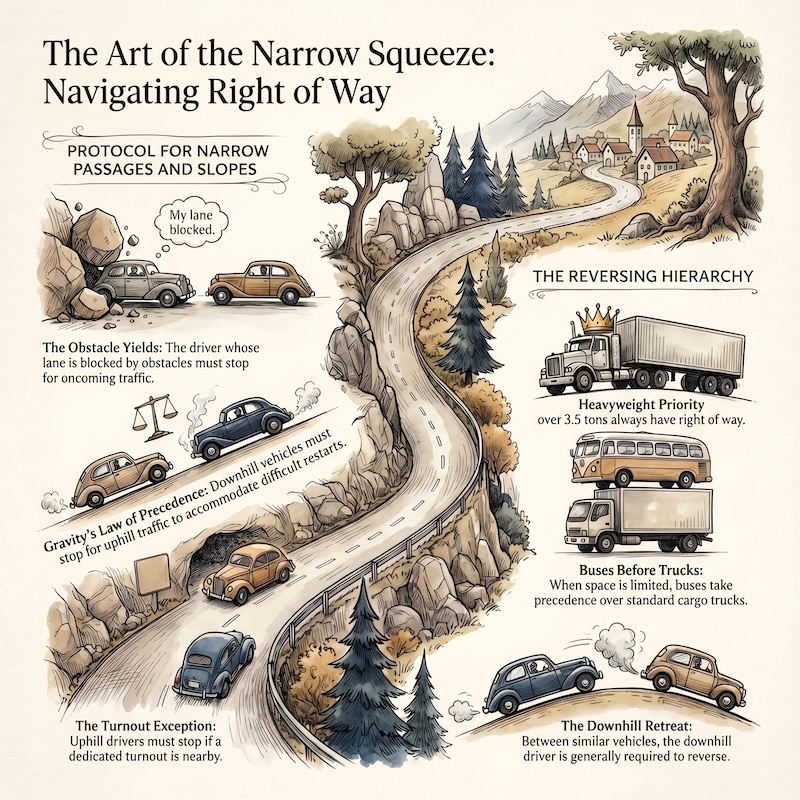
When two vehicles meet on a section of road obstructed by roadworks, parked vehicles, or other obstacles, it may not be possible for them to pass at the same time. In this situation, the driver whose direction of travel is obstructed and who cannot keep close to the right edge must stop and allow vehicles coming from the opposite direction to pass.
On mountain roads or roads with steep gradients, the main rule is that the driver traveling downhill must stop and give way to the vehicle traveling uphill. The downhill driver must move as close as possible to the right edge of the road or use a passing place if available. This is because vehicles going uphill generally have more difficulty restarting and maintaining control.
However, there is an important exception. If the driver traveling uphill is near a passing place, they must stop and use it, especially when the road is so narrow that reversing would otherwise be necessary.
When passing requires one of the vehicles to reverse, specific priority rules apply. Combinations of vehicles, such as those with trailers, have priority over other vehicles. Vehicles with a total mass over 3.5 tons have priority over lighter vehicles. Buses have priority over trucks. If both vehicles belong to the same category, generally the driver traveling downhill must reverse, unless it is clearly easier for the driver going uphill, for example if they are close to a passing place.
Failure to follow these rules results in an administrative fine. If a violation leads to a collision causing serious damage or injury, more severe penalties apply, similar to those for failing to maintain a safe distance, including possible consequences for the driving licence.
Studied the theory? Test yourself with 7,000+ official Italian Ministry questions.
📝 Start now with SuperQuizPatente