
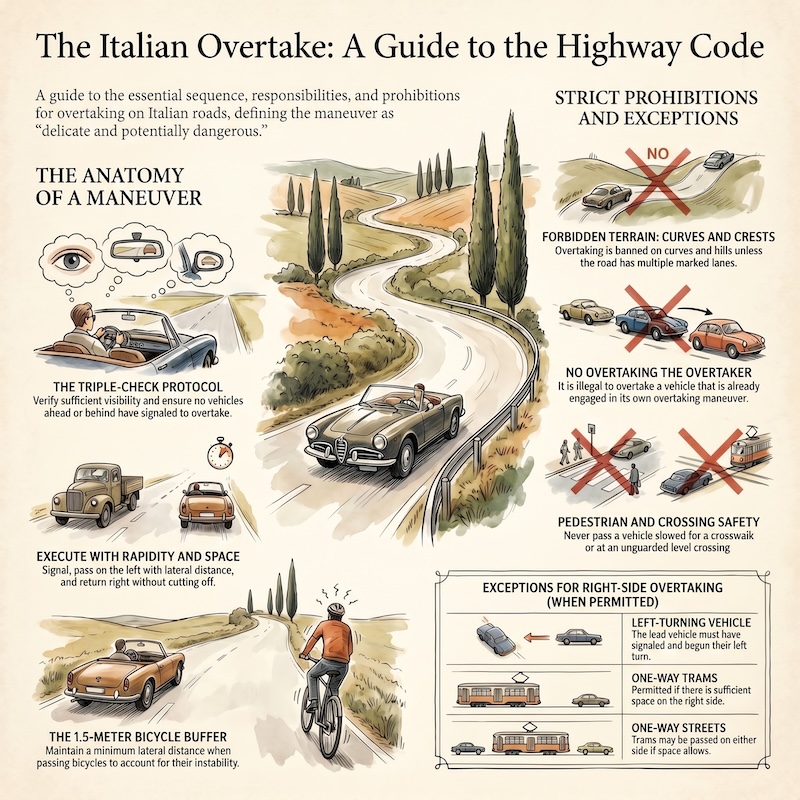
Overtaking is the maneuver by which a vehicle passes another vehicle, an animal, or a pedestrian that is moving or standing on the lane or on the part of the carriageway normally used for traffic. It is a delicate and potentially dangerous maneuver, so it may only be carried out when all safety conditions are present.
Before starting an overtaking maneuver, the driver must carefully check that visibility is sufficient and that the maneuver can be completed without creating danger or obstruction. The driver must also make sure that the vehicle ahead has not already signaled an intention to overtake, that no driver behind or on the immediately left lane has already begun overtaking, and that the road is free for a sufficient distance. This assessment must take into account not only the driver’s own speed, but also the speed of the vehicle being overtaken and of road users approaching from the opposite direction or traveling ahead of the overtaken vehicle.
As a general rule, overtaking is carried out on the left. After signaling the maneuver, the driver must move to the left of the vehicle to be passed, keep an adequate lateral distance, pass it quickly, and return to the right as soon as possible without cutting in or creating danger. If the carriageway is divided into several lanes, overtaking must be carried out using the lane immediately to the left of the vehicle being passed.
The person being overtaken must make the maneuver easier and must not accelerate. On roads with one lane for each direction, that road user must also keep as close as possible to the right edge. In addition, drivers of slow, bulky, or speed-limited vehicles, when the road does not allow easy and safe overtaking, must slow down and, if necessary, pull over as soon as possible to let following vehicles pass. In built-up areas, this rule does not apply to public service line vehicles carrying passengers.
On roads with at least two lanes for each direction, a driver who has just overtaken may remain in the same lane if another overtaking maneuver must immediately follow, but only if this does not obstruct faster vehicles approaching from behind.
In some cases, overtaking is done on the right. This is allowed when the vehicle being passed has signaled that it intends to turn left or, on a one-way road, that it intends to stop on the left, and has already begun the maneuver. Trams, when they do not travel on a reserved track, are generally overtaken on the right if there is enough room. On one-way roads, they may be overtaken on either side. However, if a tram or trolleybus is stopped in the middle of the carriageway for passengers to get on or off and there is no safety island, overtaking on the right is forbidden.
Special care is required when overtaking bicycles. Motor vehicles must leave an adequate lateral distance according to speed and the size of the motor vehicle. Where road conditions allow it, a safety distance of at least 1.5 meters must be kept. This rule exists because bicycles are less stable and therefore more vulnerable.
There are many situations in which overtaking is forbidden. It is forbidden near or on curves, crests, and in any situation of poor visibility, unless the road has separate carriageways, is one-way, or has at least two lanes in the same direction with appropriate road markings. It is forbidden to overtake a vehicle that is already overtaking another. It is also forbidden to pass vehicles that are stopped or moving slowly at railway crossings, traffic lights, or because of traffic congestion when doing so requires entering the lane for oncoming traffic.
Overtaking is also forbidden near or at intersections, but there are some exceptions. It is allowed if the vehicle ahead has signaled and begun a left turn, if it takes place on a priority road with separate carriageways, one-way traffic, or at least two clearly marked lanes in the same direction, if the overtaken vehicle is a non-motorized two-wheeler and there is no need to enter the opposite lane, or if traffic is regulated by traffic lights or traffic officers.
It is also forbidden to overtake near or at level crossings without barriers, unless traffic is controlled by traffic lights. It is forbidden as well to overtake a vehicle that has stopped or slowed down at a pedestrian crossing in order to let pedestrians cross. Drivers of vehicles with a total mass over 3.5 tons must respect, in addition to the general bans, any overtaking bans indicated by specific road signs.
Penalties vary according to the type of violation. Overtaking without observing the general rules, or overtaking on the right outside the permitted cases, leads to an administrative fine. Violations of the more serious bans, such as overtaking on curves, crests, intersections, railway crossings, or other forbidden places, lead to heavier penalties and also licence suspension. For drivers who have held a licence for less than three years, suspension is more severe in the cases established by law.
Studied the theory? Test yourself with 7,000+ official Italian Ministry questions.
📝 Start now with SuperQuizPatente