
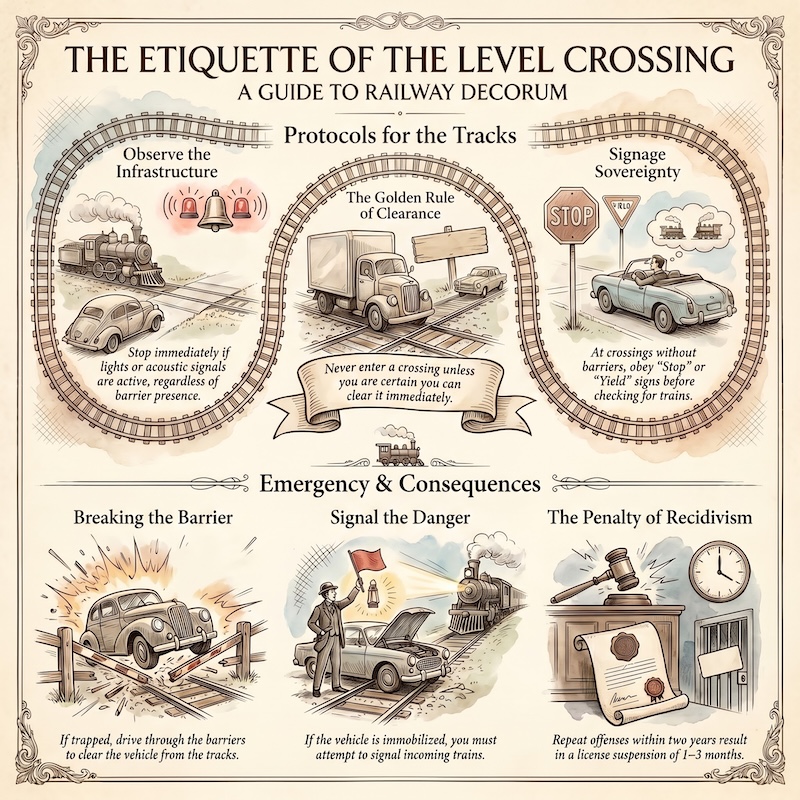
When approaching a railway crossing, the driver must exercise maximum caution, as it is one of the most dangerous points in traffic. It is mandatory to carefully observe all signs and devices such as lights, sound signals, and barriers.
At crossings without barriers and without light or sound signals, the driver’s behaviour depends on the signs. If there is only a give-way sign, the driver must ensure that no train is approaching and cross quickly only if the way is clear. If a stop sign is present, the driver must always stop before the line and proceed only after confirming that no train is coming.
When the crossing has light or sound signals, even without barriers, the driver must stop if these signals are active. This indicates that a train is approaching and crossing is forbidden.
At crossings with barriers or half-barriers, it is strictly forbidden to cross when the barriers are closed, closing, or opening. It is also forbidden to cross when light or sound signals are active or when substitute warning systems are operating.
A fundamental rule is that a driver must never enter a railway crossing unless they are sure they can clear it quickly. Entering when traffic is blocked and risking being stuck on the tracks is extremely dangerous and prohibited.
In case of emergency, such as a vehicle stopping on the tracks or being trapped between barriers, the driver must try to move it off the tracks immediately, even by breaking the barriers if necessary. If this is impossible, they must do everything possible to warn train drivers of the danger.
Violations of these rules are considered very serious and result in high fines. If repeated within two years, they may also lead to suspension of the driving licence for one to three months.
Studied the theory? Test yourself with 7,000+ official Italian Ministry questions.
📝 Start now with SuperQuizPatente