
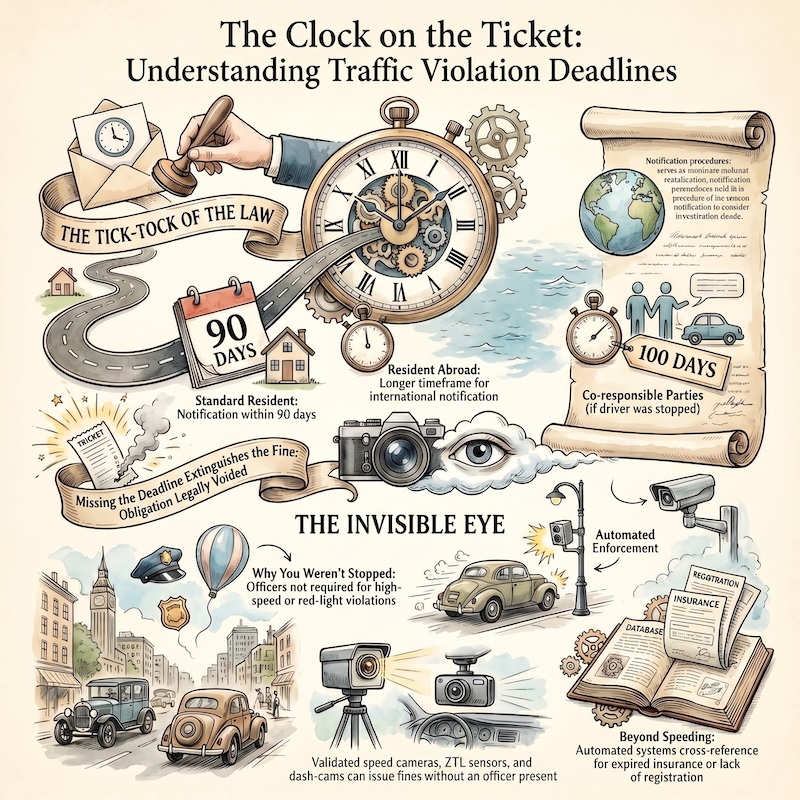
When a road traffic violation cannot be immediately notified to the driver, the report must be delivered later through formal notification. The notification must include a detailed description of the violation and explain why immediate notification was not possible. Generally, this must be done within ninety days from the date the violation was detected.
The notification is sent to the identified offender. If the offender is not immediately identified, it is sent to one of the responsible persons, such as the vehicle owner, based on official records. For individuals residing abroad, the notification period is extended up to three hundred and sixty days.
If the responsible person is identified later, the ninety-day period begins from the moment the authorities are able to identify them through official databases. If the violation was immediately notified to the driver, the report must still be sent to other responsible persons within one hundred days.
There are many situations where immediate notification is not required. For example, when a vehicle is traveling too fast to be stopped, when crossing a red light, in cases of illegal overtaking, when the driver is absent, or when the violation is detected through automated systems such as speed cameras, surveillance cameras, or access control systems in restricted traffic zones. In such cases, the violation is recorded and notified later.
Automated devices may operate without the physical presence of officers, provided they are approved and managed by competent authorities. They can also detect multiple violations at once or be used to verify additional offences, such as lack of insurance, by comparing data with official databases.
If the notification is not carried out within the prescribed time limits, the obligation to pay the fine is extinguished for the person who did not receive the notification in time.
Notification may be carried out by police officers, municipal agents, or postal services, and is valid if sent to the address registered in official records. All costs related to detection and notification are borne by the person responsible for paying the fine.
In specific cases, such as vehicles registered to public institutions, the procedure may be temporarily suspended to identify the actual driver. Additionally, on motorways and certain main roads, violations may be detected through video surveillance systems without stopping the vehicle, using recordings with certified date and time.
Studied the theory? Test yourself with 7,000+ official Italian Ministry questions.
📝 Start now with SuperQuizPatente