
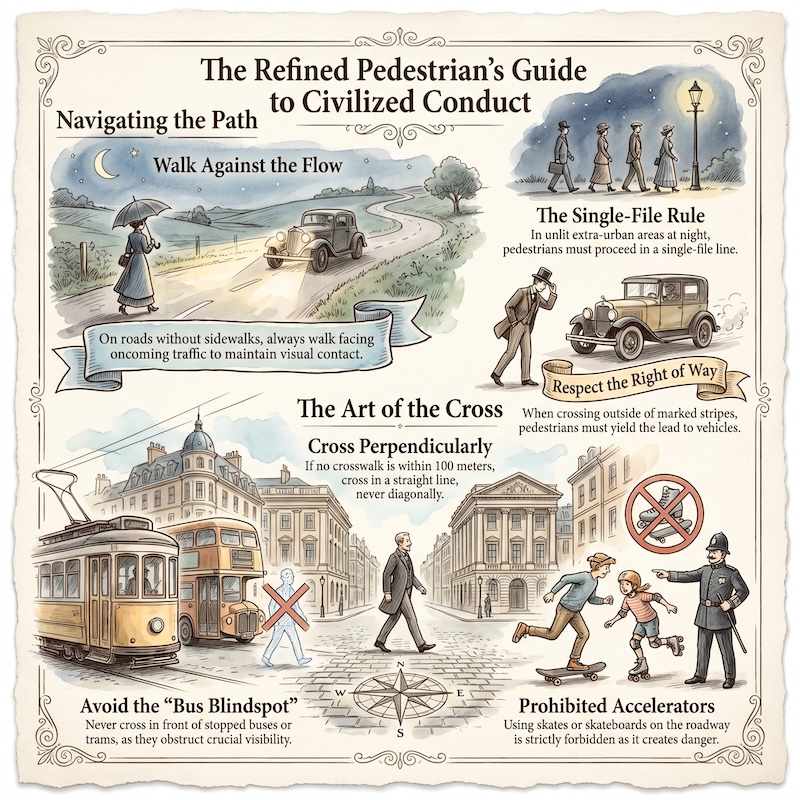
Pedestrians must walk in areas intended for them, such as sidewalks, road shoulders, pedestrian paths, and other dedicated spaces. If these spaces do not exist, are blocked, interrupted, or too narrow, pedestrians must walk along the edge of the carriageway in a way that causes as little obstruction as possible to traffic. In general, when walking on the road, pedestrians should stay on the side opposite to the direction of vehicle travel, so they can see approaching traffic. Outside built-up areas, on two-way roads, pedestrians must always walk facing the oncoming vehicles. On one-way roads, they must walk on the right edge in relation to the direction of vehicle travel. At night, from half an hour after sunset until half an hour before sunrise, if a pedestrian is walking on an extra-urban road without public lighting, they must walk in single file.
To cross the carriageway, pedestrians must use pedestrian crossings, underpasses, or overpasses. If these do not exist, or if they are more than one hundred meters away, the pedestrian may cross only in a straight line, meaning perpendicularly to the edge of the road. In that situation, the pedestrian must use great care to avoid danger for themselves or for others.
Crossing an intersection diagonally is prohibited. This means a pedestrian cannot cut across a junction at an angle just to save time. In squares and wide open road areas, if pedestrian crossings exist, they must always be used, even if they are farther away than one hundred meters. In those cases, free crossing outside the marked crossing is not allowed.
Pedestrians must not stop or remain unnecessarily on the carriageway unless there is a real need. Even on sidewalks, shoulders, or near pedestrian crossings, they must not stand in groups in a way that blocks other pedestrians. In practice, pedestrian behaviour must always be careful and must not create danger or obstruction.
When a pedestrian wants to cross in a place where there is no pedestrian crossing, they must give way to drivers. This is a very important exam point: outside the marked crossing, pedestrians do not have automatic priority and must wait until crossing is safe.
It is forbidden to cross the road by passing in front of buses, trolleybuses, or trams stopped at their stops. This rule exists because these vehicles can block visibility both for the pedestrian and for drivers of other vehicles, greatly increasing the risk of being hit. A pedestrian must wait until visibility is clear and choose a safe and permitted place to cross.
Vehicles or machines for children or for persons with disabilities, even if equipped with a motor within the limits allowed by law, may circulate in pedestrian areas according to the rules set by the competent authorities. Devices used by persons with disabilities may also circulate on cycle paths and shared pedestrian-cycle routes and, if motorized within legal limits, also on cycle tracks, cycle lanes, and certain urban cycling roads. This is meant to support the mobility of persons with disabilities while still keeping safety rules in place.
On the carriageway, it is forbidden to use skateboards, skates, or other devices that increase personal speed. It is also forbidden to carry out games, training sessions, or unauthorized sports events on the road. In pedestrian areas, the use of skateboards, skates, or similar devices is forbidden whenever it may create danger for other users. In other words, these devices must not endanger pedestrian safety.
Anyone who violates the rules for pedestrians is subject to an administrative fine. For exam preparation, it is important to remember that pedestrians also have precise legal duties: they must use the proper spaces, cross correctly, avoid causing obstruction, and avoid unnecessary danger.
Studied the theory? Test yourself with 7,000+ official Italian Ministry questions.
📝 Start now with SuperQuizPatente