
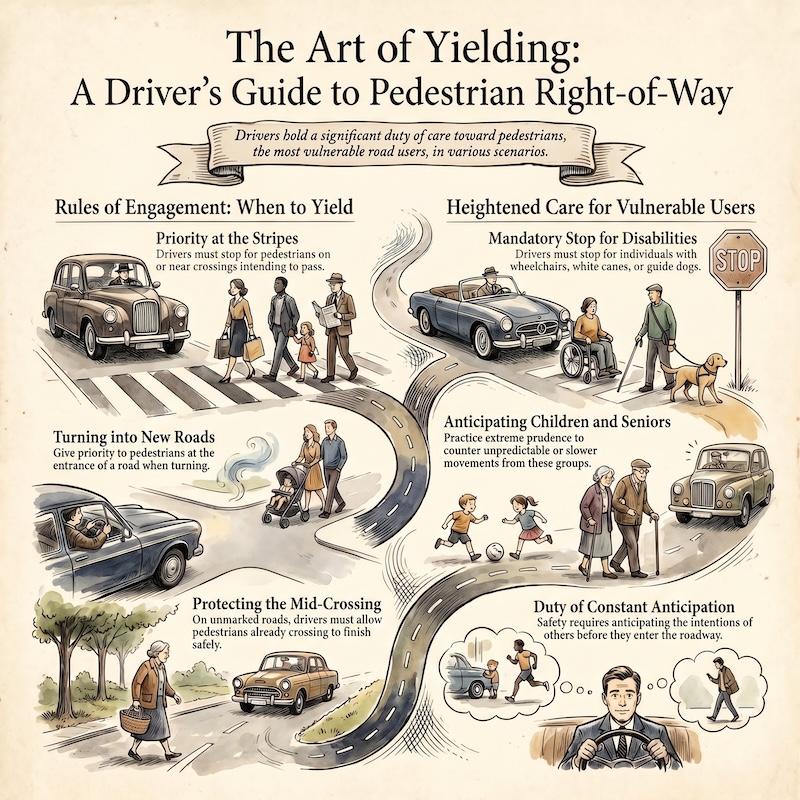
When traffic is not controlled by traffic lights or police officers, drivers must always give way to pedestrians who are crossing at pedestrian crossings or who are in the immediate vicinity with the intention to cross. This means that drivers must not only slow down, but must be ready to stop completely to allow safe crossing. The same obligation applies when a driver turns into another road where there is a pedestrian crossing at the entrance. In that situation, the driver must give way to pedestrians who are crossing or about to cross, as long as crossing is permitted for them.
Even on roads without pedestrian crossings, drivers still have obligations. If a pedestrian has already started crossing the carriageway, the driver must allow them to reach the opposite side safely. This means the driver cannot continue in a way that forces the pedestrian to stop or hurry, but must slow down or stop to avoid danger.
Special care is required for vulnerable persons. Drivers must always stop when a person with disabilities, reduced mobility, a wheelchair, a white cane, a guide dog, or a white-red cane in the case of a deaf-blind person is crossing or preparing to cross. In these situations, the obligation is stricter because these individuals may have difficulties in movement or perception of danger.
Drivers must also behave cautiously in the presence of children and elderly people. Even if they have not yet started crossing, if it is reasonable to expect that they might do so or behave unpredictably, the driver must slow down and prevent any dangerous situation. This requires constant attention and the ability to anticipate the behaviour of other road users.
For theory exam preparation, it is essential to understand that giving way to pedestrians does not only apply when they are already on the crossing, but also when they are near it and intend to cross. Additionally, the duty of care increases in the presence of vulnerable users such as disabled persons, children, and elderly people.
Violation of these rules results in an administrative penalty. However, beyond the penalty, it is important to understand that these rules are essential for protecting pedestrians, who are among the most vulnerable road users.
Studied the theory? Test yourself with 7,000+ official Italian Ministry questions.
📝 Start now with SuperQuizPatente