
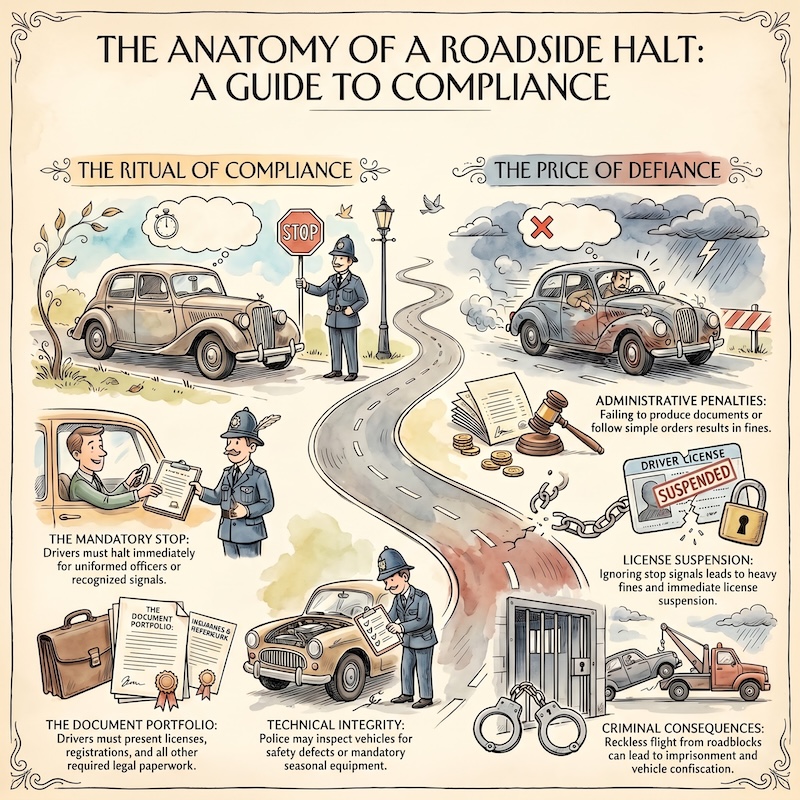
Anyone using the road must stop when instructed by officers responsible for road policing, provided they are in uniform or clearly identifiable by an official signal. This obligation is essential and cannot be ignored, as it ensures effective control and safety on the road.
Drivers must also present all required documents when requested. These include the driving licence, the vehicle registration document, and any other documents required by traffic laws. It is therefore important to always carry these documents while driving, because failure to show them leads to a penalty.
Law enforcement officers are authorized to inspect vehicles. They may check that the vehicle complies with legal requirements, including its technical characteristics and equipment. If serious defects are found, such as problems with lighting devices or tyres that could endanger safety, officers may order the driver not to continue the journey until the issue is resolved.
In specific conditions, such as snow or ice, officers may also verify that the vehicle is equipped with anti-skid devices, such as chains or winter tyres. If these are required and the vehicle does not have them, the driver may be ordered to stop or to proceed only with specific precautions.
Police authorities may set up checkpoints to carry out inspections. If a vehicle does not stop when ordered with appropriate signals, special means may be used to stop it safely without causing accidents. This highlights the importance of always complying with stop orders.
Drivers must also follow instructions given by military personnel when necessary to allow military convoys to pass safely. In this case as well, the obligation is immediate and must be respected.
Penalties depend on the seriousness of the violation. Failure to show documents, failure to follow officers’ orders, or ignoring safety instructions regarding the vehicle leads to administrative fines. Not stopping when ordered by police results in a more serious penalty and, in case of repeated violations, may also lead to licence suspension.
A more serious situation occurs when a driver does not stop at a checkpoint. In this case, the fine is very high and licence suspension is applied. If the driver attempts to flee in a way that endangers others, it becomes a criminal offence punishable by imprisonment, licence suspension, and confiscation of the vehicle, unless it belongs to a person unrelated to the offence.
For the theory exam, it is essential to remember that orders from law enforcement must always be obeyed. Failing to stop or trying to avoid a control is considered a very serious offence with both administrative and criminal consequences.
Studied the theory? Test yourself with 7,000+ official Italian Ministry questions.
📝 Start now with SuperQuizPatente