
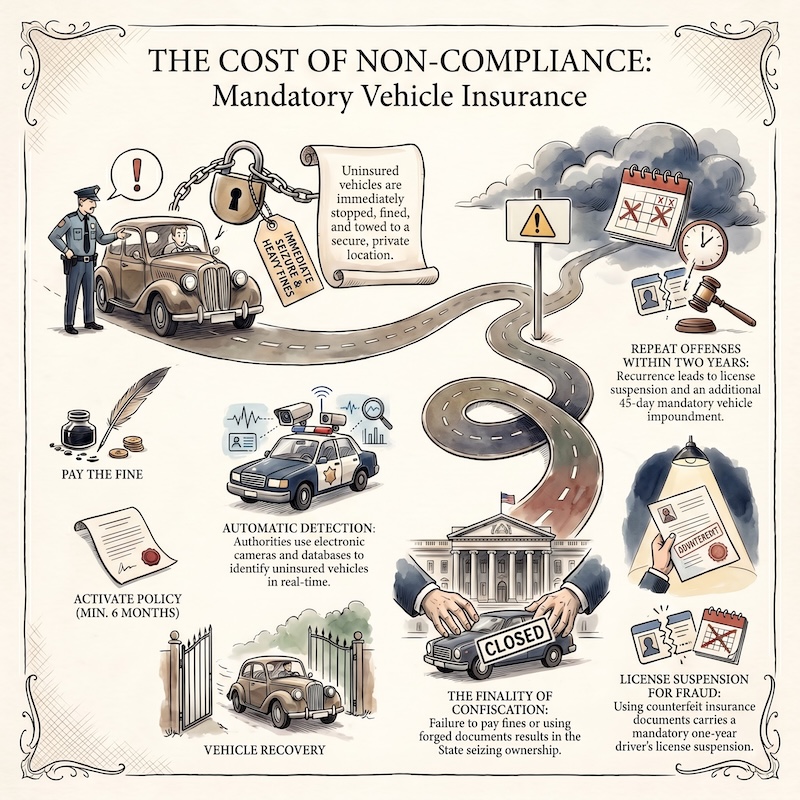
To drive on the road, every vehicle must be covered by third-party liability insurance. This insurance ensures that any damage caused to other people or property in the event of an accident can be compensated. Without this coverage, the vehicle is not allowed to circulate. Even if the vehicle is used by another person, the owner remains responsible for ensuring that it is properly insured.
Anyone driving without insurance is subject to a very high administrative fine. In addition to the fine, the vehicle is immediately stopped and cannot continue to circulate. It is seized and taken to a secure location. To recover the vehicle, the owner must pay the fine, obtain insurance coverage for at least six months, and cover all costs related to towing, transport, and storage.
If the same violation is committed more than once within a two-year period, the consequences become more severe. In addition to the fine, the driving licence is suspended. Furthermore, even after paying the fine and activating insurance, the vehicle is not immediately returned but is subject to administrative detention for forty-five days.
In some cases, the law allows a reduction of the penalty. For example, if the insurance is reactivated within a short time after it expired, or if the owner decides to scrap the vehicle and remove it from the official registers within a specified period. In the latter case, the vehicle may only be used for transport to demolition, and a deposit must be paid, which is later partially refunded.
If the fine is not paid and no appeal is made within the required time, the vehicle may be permanently confiscated. This means it becomes property of the state and the owner loses it.
A particularly serious case involves the use of false or forged insurance documents. In this situation, the vehicle is always confiscated, and the person responsible faces a one-year suspension of their driving licence. This is considered a very serious violation with significant consequences.
Insurance checks may also be carried out automatically. Authorities can compare insurance data with information collected by electronic systems, such as cameras and automatic detection devices. If a vehicle is found to be circulating without insurance, the owner is asked to prove that coverage exists. The photographic and electronic data collected are legally valid evidence of the vehicle’s presence on the road.
There are some exceptions. Vehicles that are formally withdrawn from circulation, or whose use is temporarily or permanently prohibited, are not subject to the insurance obligation. The same applies to vehicles that are not fit for use or whose use has been voluntarily suspended with proper notification to the insurance company.
For theory exam preparation, it is essential to remember that insurance is mandatory for all vehicles in circulation. Driving without insurance leads to serious consequences, including heavy fines, seizure of the vehicle, and in the most serious cases, permanent loss of the vehicle.
Studied the theory? Test yourself with 7,000+ official Italian Ministry questions.
📝 Start now with SuperQuizPatente