
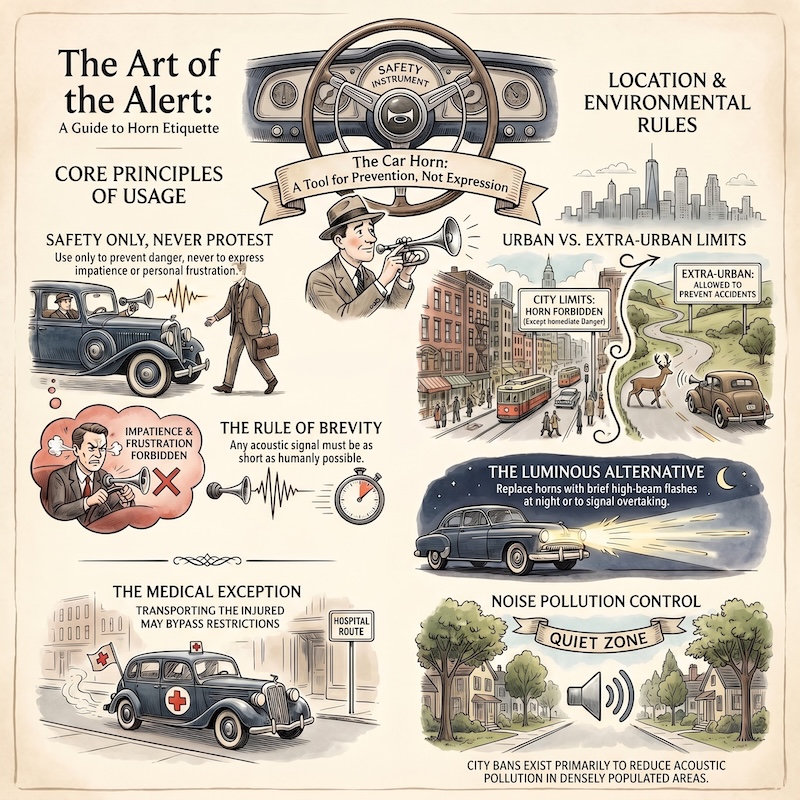
The acoustic signaling device, commonly known as the horn, must be used with great moderation and only for road safety purposes. It must not be used unnecessarily or excessively, but only when it is truly needed to prevent dangerous situations. The sound should also be as brief as possible.
Outside built-up areas, the horn may be used whenever traffic or environmental conditions require it to prevent accidents. A typical example is during overtaking, when it is used to signal presence to other road users. At night, or even during the day if necessary, the horn may be replaced by brief flashing of the high beam headlights, provided this is not prohibited.
In built-up areas, the use of the horn is generally prohibited, except in cases of immediate danger. This rule helps reduce noise pollution in urban areas. At night in cities, it is preferable to use light signals (brief flashes of high beams) instead of the horn.
There is an exception for vehicles transporting injured or seriously ill persons. In such cases, drivers may use the horn even beyond normal limitations if necessary.
In summary, the horn is a safety device, not a tool for communication or expressing frustration. Improper use results in administrative fines. For the theory exam, it is important to remember that the horn should only be used to avoid danger.
Studied the theory? Test yourself with 7,000+ official Italian Ministry questions.
📝 Start now with SuperQuizPatente