
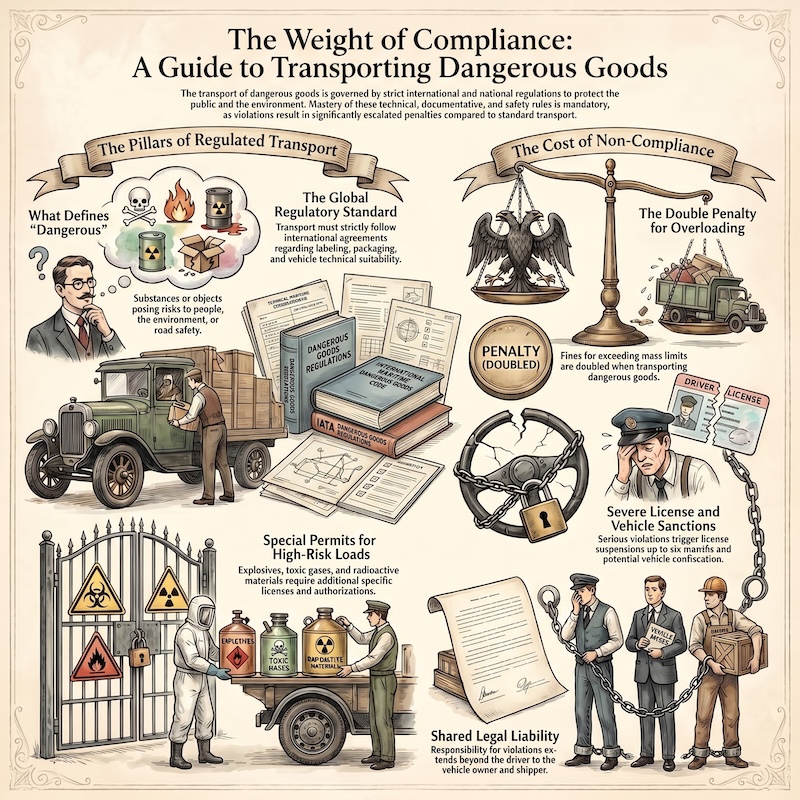
In road transport, dangerous goods are all substances and objects that belong to the classes identified by international agreements on the transport of dangerous goods. In practice, these are materials which, because of their nature, may create risks for people, the environment, vehicles, or road safety. For this reason, their transport is subject to very strict rules.
The circulation of vehicles carrying dangerous goods, as well as the rules on labeling, packaging, loading, unloading, and stowage, must comply with the international agreements incorporated into Italian law. This means that it is not enough for a substance to be allowed for transport. The entire operation must follow precise requirements concerning the vehicle, tank, containers, transport documents, and danger markings.
Dangerous goods allowed for international transport may also be carried within Italy under the same conditions established for international transport. However, for some particularly sensitive substances, such as explosive materials or toxic gases, specific licences or permits may still be required under other laws. In some cases, the Ministry may impose stricter national rules for safety reasons, as long as these do not concern the construction of the vehicles themselves. The Ministry may also classify other similar substances as dangerous and establish the conditions under which they may be transported. In special situations, an individual authorization, limited in time, may be granted for transport operations that are normally prohibited or allowed only under different conditions, but only when there are specific technical reasons or public safety needs.
For radioactive and fissile materials, additional special rules apply under separate legislation. In certain cases, provided safety is not compromised, exemptions may also be granted for small quantities of dangerous goods or for local transport over short distances.
If a vehicle carrying dangerous goods exceeds the maximum total mass shown in the registration document, the penalties for overloading apply in doubled form. This shows how seriously overloading is treated when dangerous goods are involved, because it increases the risk even further.
Transporting dangerous goods without the required authorization, when one is necessary, or failing to comply with the safety conditions imposed by the authorization, is a very serious offence. In such cases, very high financial penalties apply, together with suspension of the registration document and the driving licence for a period from two to six months. If the offence is repeated, the vehicle may also be confiscated.
Serious penalties also apply to violations concerning the technical suitability of the vehicle or tank, protective and safety equipment, orange plates or danger labels, the correct arrangement of packages, parking, loading, unloading, and the combined carriage of incompatible dangerous goods. In these cases, if responsibility lies with the carrier or the driver, both the driving licence and the registration document may be suspended in addition to the fine. Violations concerning the protective equipment of the driver or crew, transport documentation, and safety instructions are also punished.
Other breaches of the rules on dangerous goods transport are also sanctioned, even if less severely than the most dangerous cases. In any event, when such violations are established, the rules on responsibility also apply to the driver, the vehicle owner, and, in some situations, the transport client.
Compliance may be checked using approved static or dynamic weighing instruments, as well as transport documents. The costs of the checks are borne by the responsible parties. The same rules also apply to vehicles registered abroad.
For theory exam preparation, it is important to remember one essential principle: dangerous goods may be transported only if all technical, documentary, and safety requirements are fully respected. Missing authorizations, signs, equipment, or correct transport conditions are considered particularly serious because they endanger not only the driver, but all road users and the environment.
Studied the theory? Test yourself with 7,000+ official Italian Ministry questions.
📝 Start now with SuperQuizPatente