
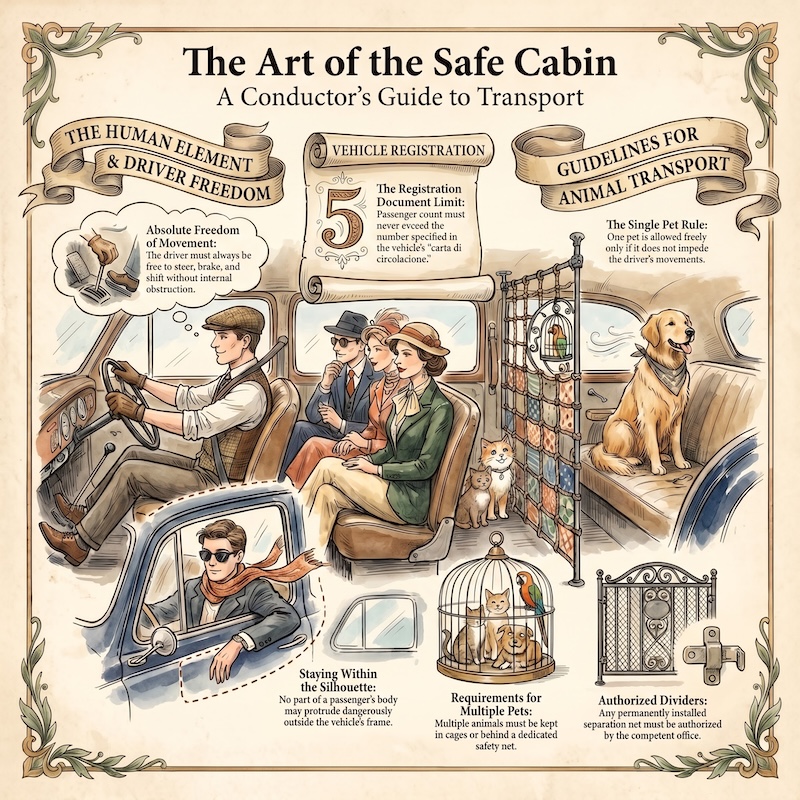
While driving, the driver must always have the greatest possible freedom of movement. This means that no person, animal, or object carried in the vehicle may interfere with the movements needed to steer, brake, change gear, or perform any other driving maneuver. Likewise, the driver must keep full visibility and must not be disturbed by what is inside the vehicle.
The maximum number of people that may be carried in a vehicle cannot exceed the number shown in the registration document. This rule generally applies to all vehicles, taking into account the number and arrangement of seats. For motor vehicles intended for passenger transport other than ordinary cars, such as buses and trolleybuses, both the maximum number of passengers and the maximum total load shown in the vehicle documents must be respected.
All passengers must sit or position themselves in such a way that they do not limit the driver’s movements or prevent proper visibility of the road. In addition, in motor vehicles other than motorcycles and two-wheeled mopeds, neither the driver nor the passengers may stick out sideways beyond the width of the vehicle. In practical terms, no part of the body may project dangerously outside the vehicle.
As for the transport of domestic animals, carrying more than one animal is not allowed if this creates an obstruction or danger for driving. However, it is permitted to carry several domestic animals if they are kept in a cage, in a suitable container, or in the rear compartment separated from the driver’s area by a net or another suitable device. If this separating system is installed permanently, it must be authorized by the competent office.
Violations relating to carrying too many people are punished differently depending on the type of vehicle. If the offence concerns vehicles intended for passenger transport other than cars, the penalty is more serious. If it concerns a car, the penalty is lower, but it still applies. If the vehicle is unlawfully used to transport people on behalf of others, the penalty becomes even more severe and may also include suspension of the registration document.
For theory exam preparation, it is important to remember that transporting people, animals, and objects is allowed only if it does not compromise driving safety, does not exceed the limits stated in the vehicle documents, and everything carried in the vehicle is arranged so that it does not create danger.
Studied the theory? Test yourself with 7,000+ official Italian Ministry questions.
📝 Start now with SuperQuizPatente