
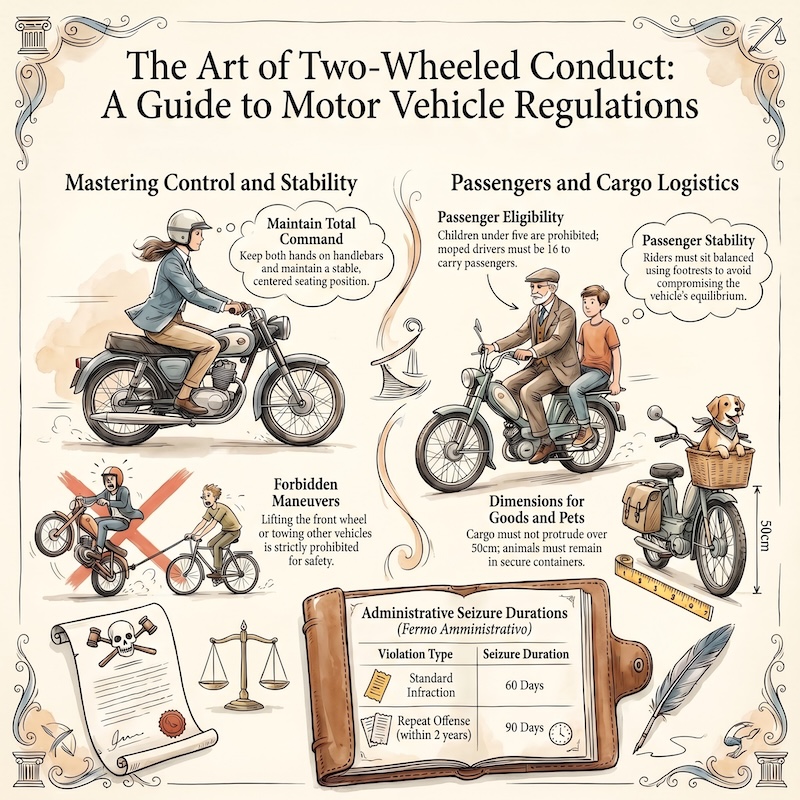
When riding a motorcycle or a two-wheeled moped, the rider must always have full control of the vehicle. They must be able to freely use their arms, hands, and legs, maintain a correct and stable seated position, and hold the handlebars with both hands. Using one hand is allowed only when necessary, for example to give signals or perform specific maneuvers. Riding with the front wheel lifted off the ground is prohibited because it reduces control and increases the risk of accidents.
It is not allowed to carry children under five years of age on motorcycles or mopeds. This rule is important because very young children are not able to maintain a safe and stable position during travel.
As for mopeds, carrying passengers is generally prohibited. However, it is allowed only if the vehicle is approved for carrying a passenger, meaning there is a designated seat indicated in the registration document, and if the rider is at least sixteen years old. Without these conditions, the rider must travel alone.
When a passenger is present, they must sit in a stable and balanced way, using the vehicle’s equipment properly, such as the seat and footrests. An incorrect position of the passenger can affect the balance of the vehicle and make riding dangerous.
It is forbidden to tow another vehicle or to be towed while riding a motorcycle or moped. This practice is extremely dangerous because it makes the vehicle difficult to control and can easily lead to accidents.
As for carrying objects, they must be securely fastened and must not extend sideways beyond the vehicle’s axis or forward or backward beyond fifty centimeters from its outline. They must not obstruct the rider’s visibility. Animals may be transported only if they are kept in a suitable cage or container and within these limits.
Violations of these rules result in financial penalties. In some cases, such as certain violations related to riding behavior or passenger transport, the vehicle may also be subject to administrative detention for sixty days. If the same violations are repeated within two years, the detention period may be extended to ninety days.
For theory exam preparation, it is essential to remember that stability and control are crucial on two-wheeled vehicles. Any behavior that reduces balance, limits the rider’s movements, or creates danger, such as carrying unauthorized passengers, unsecured objects, or unprotected animals, is prohibited and punishable.
Studied the theory? Test yourself with 7,000+ official Italian Ministry questions.
📝 Start now with SuperQuizPatente