
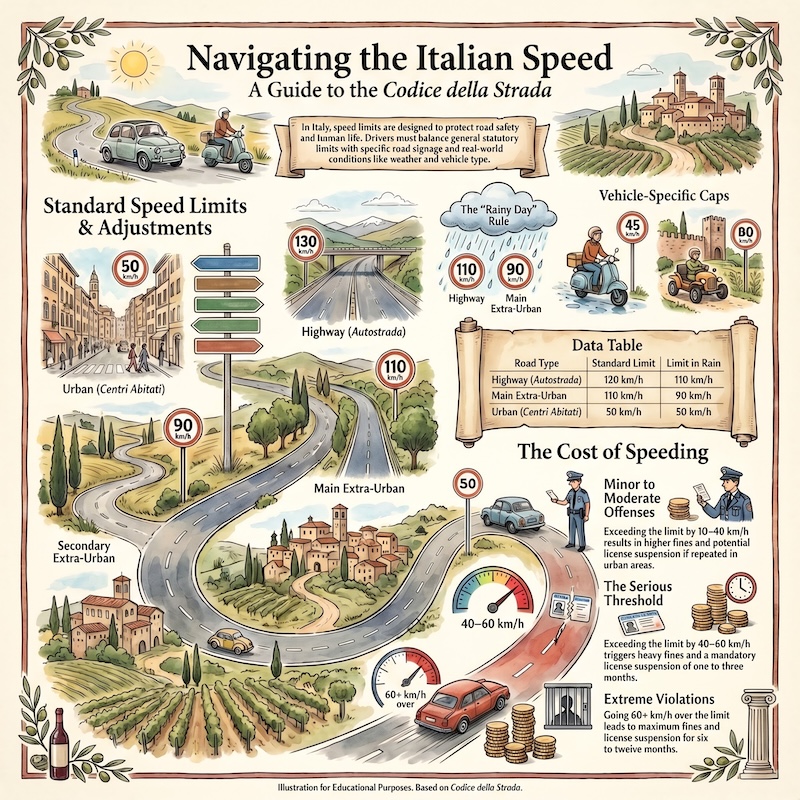
Speed limits exist to protect road safety and human life. As a general rule in Italy, the maximum speed is 130 km/h on motorways, 110 km/h on main extra-urban roads, 90 km/h on secondary and local extra-urban roads, and 50 km/h in built-up areas. On some urban roads, if their design and function allow it and if proper signs are installed, the limit may be increased up to 70 km/h. On certain motorways with at least three lanes in each direction plus an emergency lane, and equipped with approved systems for measuring average speed, the limit may be raised up to 150 km/h, but only if road design, traffic conditions, weather, and accident data make this appropriate. In case of rain or any kind of precipitation, the maximum speed is reduced: on motorways it cannot exceed 110 km/h, and on main extra-urban roads it cannot exceed 90 km/h.
Within these general limits, the road authority may set different minimum or maximum speed limits for specific roads or sections when local conditions require it. These limits must be clearly indicated by signs and must be changed or removed when the reasons for them no longer exist. This means that drivers must pay attention not only to the general limits in the law, but also to the road signs present on the route.
Some categories of vehicles have lower special limits. Mopeds cannot exceed 45 km/h. Vehicles carrying certain dangerous goods are subject to particularly low limits. Agricultural machines and work machines have different limits depending on their equipment. Quadricycles cannot exceed 80 km/h outside built-up areas. Vehicles towing trailers, buses, trolleybuses, trucks, and other heavy vehicles must also follow lower limits than ordinary cars. For many of these vehicles, the maximum permitted speed must be shown on the rear so that it is visible to other road users.
Even when there is a fixed speed limit set by law or by signs, the general duty of caution still applies. In other words, it is not enough to remain below the numerical limit. The driver must still adjust speed to the actual road, traffic, visibility, and vehicle conditions, as required by the general rule on safe speed.
Compliance with speed limits may be checked through approved devices, both for measuring instantaneous speed and for calculating average speed over a section of road. Tachograph records and motorway travel documents may also be used as evidence. Speed control points must be announced in advance and must be clearly visible. If the same vehicle commits several speed violations within a short period, on roads under the authority of the same body and within no more than one hour, a more favorable rule may apply, based on the most serious violation increased by one third.
Penalties depend on how much the speed limit is exceeded or on other speed-related violations. If a driver fails to observe a minimum speed or exceeds the maximum speed by no more than 10 km/h, a lower fine applies. If the excess is more than 10 km/h but no more than 40 km/h, the fine is higher. If this happens in a built-up area at least twice within one year, the driver may also face licence suspension for a short period in addition to the fine. If the excess is more than 40 km/h but no more than 60 km/h, the financial penalty becomes much more severe and licence suspension from one to three months is added. If the excess is over 60 km/h, the fine is even higher and the licence is suspended for six to twelve months.
For certain more dangerous or heavier categories of vehicles, such as buses, trucks, vehicles with trailers, or vehicles carrying specific goods, both the financial penalties and additional sanctions are doubled. If, within two years, the driver commits another very serious offence involving an excess of more than 40 km/h, the suspension becomes longer. If, within two years, another offence involving an excess of more than 60 km/h is committed, the licence may even be revoked.
Money collected from speed fines detected through speed control systems is divided between the road authority and the authority responsible for the officers who carried out the enforcement. These sums must be used for road maintenance, safety improvements, road signs, barriers, and stronger traffic enforcement. Local authorities must report every year on how these funds are used.
Studied the theory? Test yourself with 7,000+ official Italian Ministry questions.
📝 Start now with SuperQuizPatente