
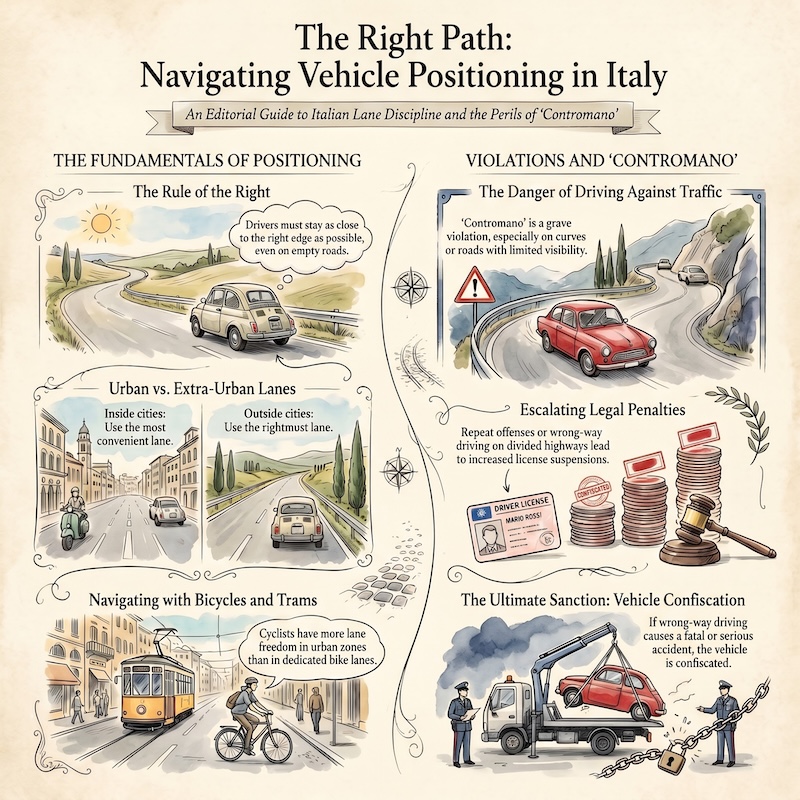
Vehicles must normally travel on the right side of the carriageway and as close as possible to the right edge, even when the road is empty. This is the basic rule of circulation and it helps maintain order, safety, and predictability in vehicle movements. Non-motorized vehicles and animals must also keep as close as possible to the right edge.
For bicycles, there are some special rules in urban cycling infrastructure. In bicycle waiting areas, urban cycling streets, and bicycle zones, bicycles may occupy any position on the carriageway. In bicycle lanes, however, they must keep to the outermost part of the lane. This means that the correct position of a bicycle depends on the type of road space in use.
The obligation to stay as close as possible to the right edge also applies to other vehicles when meeting oncoming traffic or when driving through curves or convex bends with limited visibility, except in certain situations. This rule does not apply in the same way on roads with separate carriageways, roads with at least two lanes for each direction, or one-way roads, where the road layout is different.
When a road is divided into two separate carriageways, the driver must use the right-hand one. If the road is divided into three separate carriageways, the driver must use the right-hand or the central one, unless signs indicate otherwise. In practice, the driver must always choose the carriageway that corresponds to the direction of travel and to the road signs.
On roads with two or more lanes in the same direction, outside built-up areas the driver must use the free lane furthest to the right. The left lanes are normally reserved for overtaking. The same basic rule applies in built-up areas, but there is more flexibility there: the driver may use the lane that is most suitable for the direction intended at the next intersection. For example, if the driver plans to turn left, it is allowed to move in advance into a more suitable lane. However, lane changes are not completely free. They are allowed only to prepare for turning, stopping, or overtaking. In urban areas, in these situations, overtaking on the right may also be allowed.
On roads with tram tracks level with the carriageway, vehicles may drive on the tracks only if they do not obstruct or slow down the tram, unless signs provide otherwise. If there are two tram tracks on one side of the carriageway, vehicles may also travel to the left of the track area, as long as they remain within the part of the road intended for their direction of travel. If a tram or trolleybus stop has a safety island, vehicles may pass either to the right or to the left of it, unless signs require a specific side, provided they remain in the correct part of the carriageway and do not interfere with passengers.
Driving in the wrong direction is a serious offence. In general, anyone driving against the permitted direction is subject to a penalty. The offence becomes even more serious if it happens in a curve, on a convex bend, in limited visibility conditions, or on the wrong carriageway of a road divided into separate carriageways. In these cases, besides the fine, licence suspension is also imposed, and it becomes longer in case of repeated offences. If wrong-way driving causes an accident resulting in death or serious or very serious injury, the vehicle is always confiscated.
Other violations of the rules on vehicle position on the carriageway also lead to administrative penalties. For the theory exam, it is important to remember not only the general rule of keeping to the right, but also the exceptions related to lanes, built-up areas, trams, and cycling infrastructure.
Studied the theory? Test yourself with 7,000+ official Italian Ministry questions.
📝 Start now with SuperQuizPatente