

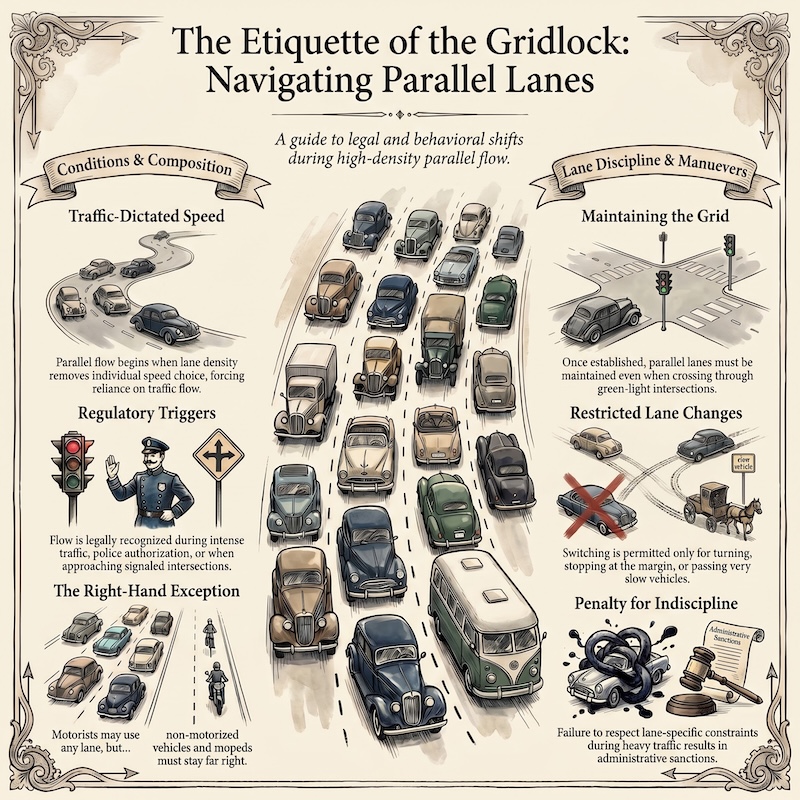
Parallel traffic occurs on roads with at least two lanes in each direction when traffic is so dense that vehicles occupy the entire carriageway and move at a speed determined by the vehicles ahead. In such conditions, drivers do not have full freedom to choose their speed or lane, as they are influenced by the flow of traffic. This type of driving is also allowed when authorized by traffic officers or on road sections leading to intersections controlled by traffic lights or manual signals. In these cases, when the light turns green, vehicles must continue moving in parallel lanes even within the intersection.
During parallel traffic, drivers of motor vehicles are not required to keep close to the right edge of the carriageway, but they must remain within their chosen lane. This rule does not apply to non-motorized vehicles and mopeds, which must still keep close to the right edge.
Changing lanes in these situations is restricted and cannot be done freely. It is allowed only in specific cases, such as when preparing to turn right or left, or when slowing down and stopping at the edge of the carriageway where permitted. Drivers in the right lane may also move to another lane to overtake very slow or non-motorized vehicles, provided they signal properly.
Failure to comply with these rules results in administrative penalties. For exam preparation, it is important to understand that in heavy traffic conditions some normal rules change, but lane discipline and correct signaling remain essential.
🔗 Read the official text of Art. 144 on the ACI portal (Italian)
❓ Frequently asked questions
🚦 Practice with Italian driving quizzes
Studied the theory? Test yourself with 7,000+ official Italian Ministry questions.
📝 Start now with SuperQuizPatente