
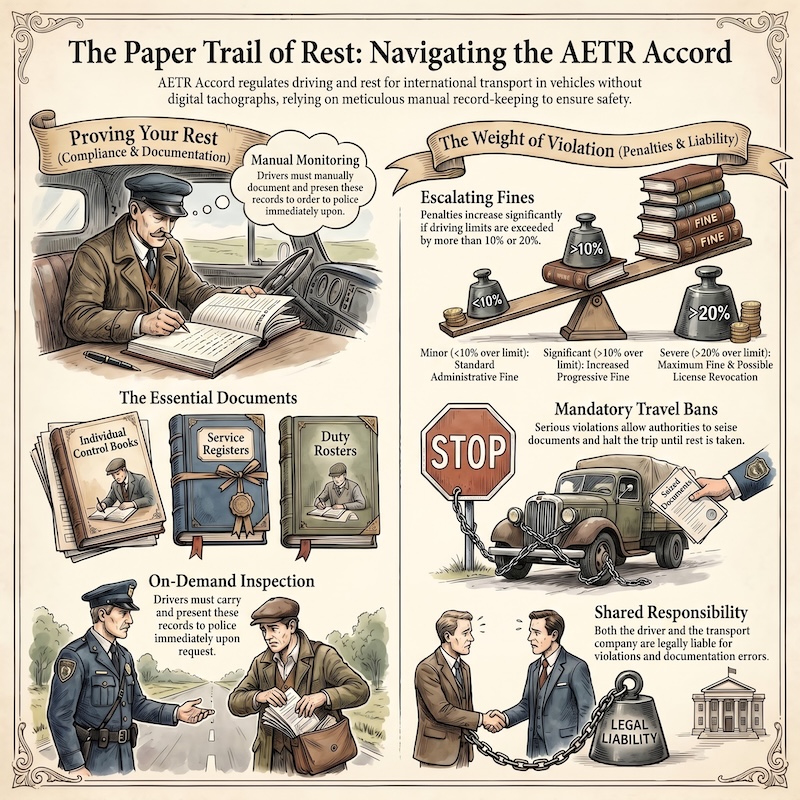
For certain professional transport operations carried out with vehicles not equipped with a tachograph, driving time, breaks, and rest periods are not left to the free decision of the driver or the company, but are governed by specific rules laid down in the international AETR agreement. This agreement applies in particular to certain international road transport operations and ensures that, even without a tachograph, the driver does not drive for too long without stopping and does not reduce rest below the permitted limits.
The driver must therefore respect precise limits for daily and weekly driving, breaks during driving, and minimum rest periods. The principle is the same as in other professional transport: preventing driver fatigue and reducing the risk of accidents caused by tiredness or lack of attention.
Since the vehicle is not equipped with the usual control device required in other cases, compliance with the rules must be proved through specific documents. These include the individual control booklet, service registers, extracts from the service register, and copies of the service timetable. The driver must carry the necessary documents and show them to road police officers when requested. Some documents must also be kept by the company and shown to the competent control authorities.
Violations may be detected both through any control devices installed on the vehicle and through the examination of travel documents. For this reason, it is important not only to comply with driving and rest times, but also to complete and keep the documentation correctly, fully, and truthfully.
If the driver exceeds the driving limits or fails to respect daily or weekly rest periods, administrative penalties apply. The penalties increase according to the seriousness of the violation. If the excess driving time or reduced rest is relatively limited, the penalty is lower. If the excess is more than 10 percent or 20 percent above or below the permitted limits, the fine becomes progressively higher. Failure to respect mandatory breaks during driving is also punished.
The driver is also punished if they do not carry the individual booklet, the service register extract, or the copy of the service timetable, or if these documents are incomplete or altered. In such cases the violation is particularly important because it prevents proper verification of compliance. If the alteration of documents also amounts to a criminal offence, criminal rules may apply as well.
When the violations concerning driving or rest times are significant, immediate measures affecting the ongoing journey may be taken in addition to the fine. In these cases, the same rules apply as under article 174: the enforcing authority may temporarily withdraw the driving documents, prohibit continuation of the journey, and require the driver to complete the necessary break or rest before starting again. If the driver ignores this order and continues the journey, the violation becomes even more serious.
The same penalties also apply to other crew members when they are subject to the same obligations and fail to comply. In addition, the company employing the driver is jointly liable with the driver for payment of the penalty. This means that responsibility does not fall only on the individual driver, but also on the transport organization.
The company may also be penalized directly if it does not comply with the AETR rules or if it does not correctly keep the required documents, or keeps them expired, incomplete, or altered. In the case of repeated violations, more serious measures apply, similar to those provided for transport governed by article 174, including suspension or revocation of the authorization that allows the transport activity. If the vehicles are registered in States outside the European Union or the European Economic Area, these measures may concern the authorization that permits international transport.
For theory exam preparation, it is important to remember that even when a vehicle is not equipped with a tachograph, the professional driver must still comply with driving times, breaks, and rest periods. The main difference is that control takes place mainly through travel documents. The essential principle remains the same: no professional transport should be carried out under conditions of fatigue or without the ability to prove compliance with the rules.
Studied the theory? Test yourself with 7,000+ official Italian Ministry questions.
📝 Start now with SuperQuizPatente