
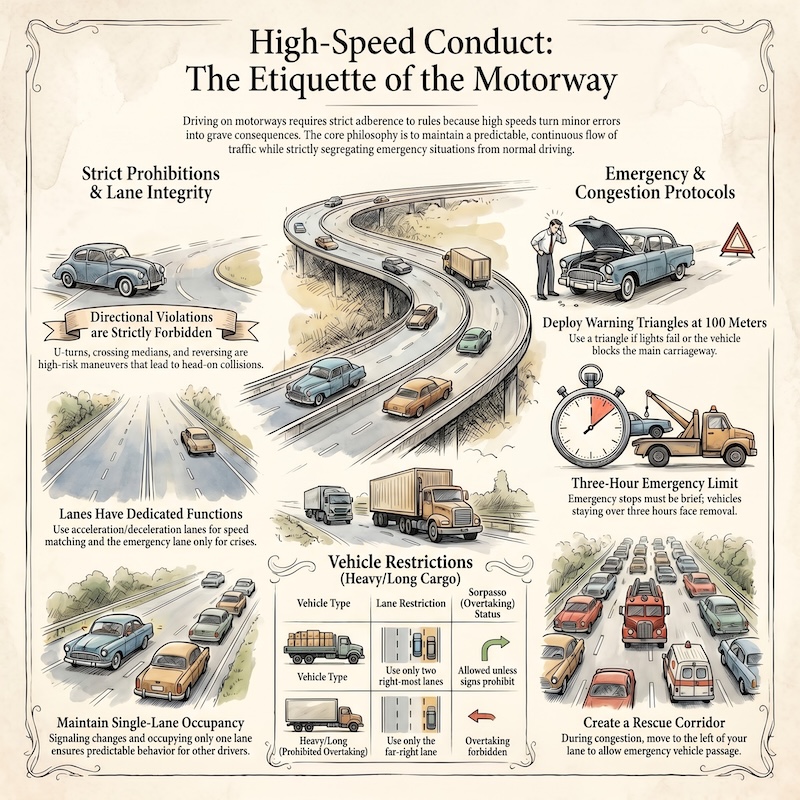
On motorways and main extra-urban roads, traffic rules are particularly strict because these are high-speed roads where every mistake can have very serious consequences. For this reason, all manoeuvres that may surprise other drivers or interrupt the normal flow of traffic are prohibited.
It is absolutely forbidden to make a U-turn, cross the central reservation, even at openings, or drive in the opposite direction to that permitted. This is one of the most serious offences because it creates a risk of high-speed head-on collisions. Reversing is also forbidden, including on the emergency lane, except for manoeuvres strictly necessary within service or parking areas. In the same way, the emergency lane cannot be used for normal driving. It is reserved only for stopping in an emergency or for re-entering traffic after an emergency stop. Acceleration and deceleration lanes also have a specific function and may not be used improperly. The acceleration lane must be used to enter the main carriageway while giving way to vehicles already travelling on it, and the deceleration lane must be entered in good time when leaving the carriageway.
Every lane change must be signalled in advance with the direction indicators. In the event of traffic jams or long queues, vehicles in the first lane on the right must position themselves as close as possible to the line on the left side of that lane, when there is no emergency lane or it is not sufficient, so as to leave room for emergency and police vehicles. In case of a traffic jam, it is allowed to use the emergency lane only in order to leave the motorway, and only starting from the sign placed 500 meters before the exit.
Stopping or even briefly halting on carriageways, ramps, or junctions is prohibited except in emergency situations caused by vehicle breakdown or illness of an occupant. In such cases, the vehicle must be moved as quickly as possible onto the emergency lane or, if there is none, to the first available emergency bay, without obstructing the traffic lanes. Emergency stopping must last only for the time strictly necessary and in any case no longer than three hours. After that, the vehicle may be removed.
When a vehicle is stopped at night or in conditions of limited visibility, the position lights and other required lights must remain on. If the vehicle cannot be moved to the emergency lane or to an emergency bay, or if the road section has none, the driver must place the warning triangle behind the vehicle at a distance of at least 100 meters. The same obligation applies when the vehicle is on the emergency shoulder at night or in limited visibility and the position lights are not working.
On motorways with three or more lanes in each direction, certain heavier or longer vehicles, such as goods vehicles above certain limits, may not use lanes other than the two nearest to the right edge. On sections where overtaking is forbidden for such vehicles, they must use only the lane nearest the right edge. It is also forbidden to drive side by side with another vehicle in the same lane, because each vehicle must occupy one lane only and maintain clear and predictable behavior.
On toll roads, drivers must pay the toll according to the established procedures and, where required, must stop at the barriers and queue correctly. Anyone who passes through without stopping and creates danger, or who tries to avoid paying the toll in whole or in part, commits a serious offence. If the driver has no entry ticket or uses the toll system improperly, the toll is calculated from the farthest entry station for that class of vehicle, unless the driver can prove otherwise.
Anyone driving on a motorway with a vehicle that is not compliant with the required roadworthiness inspection is subject to a penalty and to administrative detention of the vehicle, which is returned only after the inspection has been booked. Certain service vehicles of the motorway operator, police, fire brigade, or ambulance services may be exempt from some prohibitions, but only for genuine service needs, with specific authorizations, and using the required flashing warning lights.
For the theory exam, it is important to remember that on motorways and main extra-urban roads driving must be orderly, continuous, and predictable. Sudden manoeuvres, improper lane use, unjustified stops, and any behaviour that may obstruct traffic or endanger others are prohibited. The most serious offences, such as driving the wrong way, reversing, or improper use of the emergency lane, lead to very severe penalties and, in the most serious cases, also to suspension or revocation of the licence and detention or confiscation of the vehicle.
Studied the theory? Test yourself with 7,000+ official Italian Ministry questions.
📝 Start now with SuperQuizPatente