
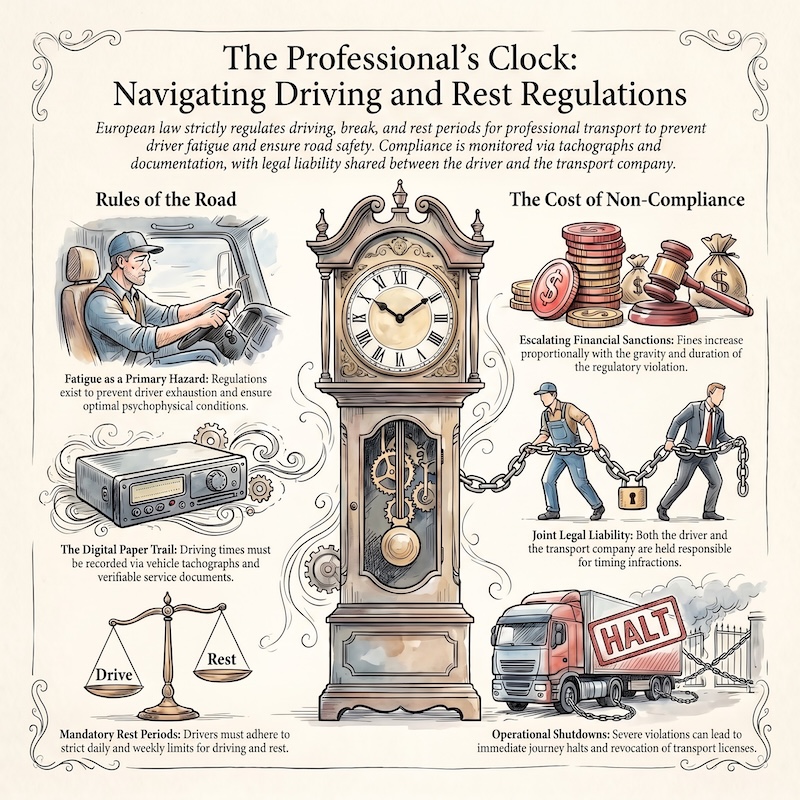
For motor vehicles used to transport people or goods, driving time, breaks, and rest periods are not left to the free choice of the driver or the company. They are regulated by precise rules laid down by European law. The main purpose of these rules is to prevent driver fatigue, which is one of the greatest dangers to road safety, especially in professional transport.
The driver must respect daily and weekly driving limits, minimum break times during driving, and minimum daily and weekly rest periods. In practice, a driver may not drive for too long without stopping, nor reduce rest below the permitted limits. These rules are intended to ensure that those driving heavy vehicles or passenger transport vehicles remain in suitable physical and mental condition.
Checks may be carried out through the devices installed in the vehicle, such as the tachograph, as well as through service documents that the driver must carry or that the company must keep. These documents must be shown to road police officers and, in certain cases, also to other competent officials. Therefore, violations can be discovered not only during a roadside stop, but also later through records and documents.
If the driver exceeds the maximum driving times or does not observe the required rest periods, administrative penalties apply. The penalties increase according to the seriousness of the violation. The greater the excess driving time or the greater the reduction in rest, the higher the fine. The same principle applies when mandatory breaks during driving are not respected.
The absence, incompleteness, or alteration of the required documents also leads to penalties. Therefore, it is not enough to comply with driving and rest times; it must also be possible to prove compliance through proper documentation.
When the violations concern particularly serious excesses in driving time or failures to rest, the enforcing authority does not limit itself to issuing a fine. It may also temporarily withdraw the driving documents and prohibit continuation of the journey until the driver has completed the necessary break or rest period. The vehicle must be taken to a suitable place and remain there for the required time. If the driver ignores this order and continues the trip anyway, the violation becomes even more serious and results in very high penalties, as well as immediate withdrawal of the driving licence.
The rules apply not only to the driver, but also to other crew members when they take part in driving activities and are subject to the same requirements. In addition, the company employing the driver is jointly liable for payment of the penalties. This means that responsibility is not only personal, but also concerns the transport organization.
The company may also be directly penalized if it does not respect the rules on driving and rest times or if it does not properly keep the required documents. If these failures are repeated over time and the company does not correct its position after a formal warning, more serious measures may be taken, such as suspension of the transport authorization. In cases of repeated and persistent non-compliance, the authorization to operate transport may even be revoked or cancelled.
For the theory exam, it is important to remember that driving and rest times in professional transport are not merely organizational rules, but true safety rules. The essential principle is that the professional driver must not drive beyond the permitted limits, must stop when required, and must always be able to prove, through control devices and documents, that the rules have been respected.
Studied the theory? Test yourself with 7,000+ official Italian Ministry questions.
📝 Start now with SuperQuizPatente