
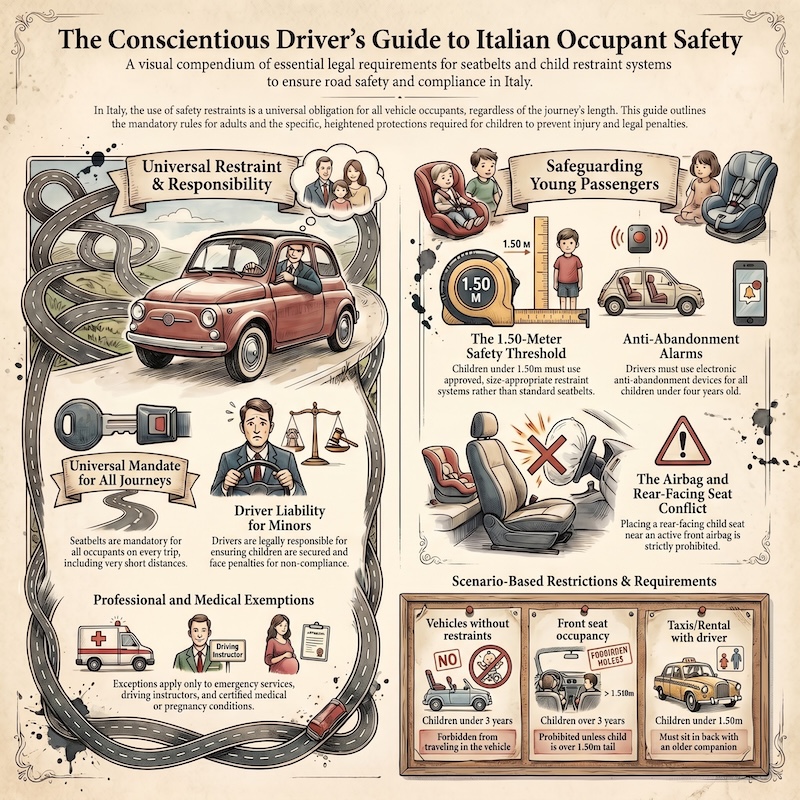
The use of seat belts is mandatory for the driver and passengers of vehicles equipped with them, especially in many categories of motor vehicles used to transport people or goods. This obligation applies in every driving situation, not only on fast roads or long journeys, but always, even for short trips. Seat belts must be worn correctly because they reduce the consequences of accidents and help keep occupants in the safest possible position in the event of a collision.
Children shorter than 1.50 meters cannot be protected only by the normal adult seat belt. They must be secured with an approved child restraint system suitable for their weight or height, according to the applicable rules. This means that the child seat or other device must be chosen correctly and installed properly. The driver also has the duty to make sure that these devices are present and working correctly.
When transporting a child under four years of age in certain vehicles, in addition to the normal child restraint system it is also mandatory to use a specific anti-abandonment alarm device. This is intended to prevent the risk of forgetting the child inside the vehicle. The obligation applies to drivers of vehicles registered in Italy and also to foreign-registered vehicles driven by residents of Italy.
If a vehicle has no restraint systems, children up to three years of age may not travel in it. Children older than three may sit in the front seat only if they are taller than 1.50 meters. This rule is important because, without adequate protection devices, a small child faces a very high risk in the event of sudden braking or an accident.
There are some exceptions for specific transport services. For example, in taxis and chauffeur-driven rental vehicles, children shorter than 1.50 meters may travel without a child restraint system, provided they do not sit in the front seat and are accompanied by a person who is at least sixteen years old. This is only a limited exception for particular situations, not the general rule.
A very important safety principle concerns rear-facing child seats. Children may not be carried in a rear-facing child seat on a passenger seat protected by an active front airbag. If the airbag deploys, the child could suffer very serious injuries. A rear-facing child seat may be used there only if the airbag has been properly deactivated.
Even on buses and other passenger vehicles in higher categories, occupants older than three years must use the safety systems provided when seated. Passengers must be informed of this obligation by signs, pictograms, announcements from the driver, or other information systems such as audiovisual messages.
The law provides some categories of people who are exempt from the obligation to use seat belts or child restraint systems. These include, in particular situations, some members of police forces, emergency services, driving instructors while performing their duties, certain people with certified medical conditions incompatible with the use of restraint systems, and in some cases pregnant women with specific medical certification. However, exemptions do not mean general freedom from the rule. They apply only in the cases expressly provided by law.
Anyone who fails to use seat belts, child restraint systems, or the anti-abandonment device when required is subject to an administrative penalty. If the violation concerns a minor, responsibility falls on the driver or, if present in the vehicle, on the person responsible for supervising the child. If the driver commits this violation more than once within two years, in addition to the fine they may also face suspension of the driving licence for a period from fifteen days to two months.
It is also forbidden to alter or obstruct the normal functioning of seat belts or restraint systems. In addition, importing, producing, or selling non-approved restraint devices is punished with high penalties, and such devices may be seized and confiscated. For theory exam preparation, it is important to remember one basic rule: every occupant must be protected with the correct device suitable for the vehicle and the person being transported, and children must always travel with specific systems appropriate to their size and safety needs.
Studied the theory? Test yourself with 7,000+ official Italian Ministry questions.
📝 Start now with SuperQuizPatente