
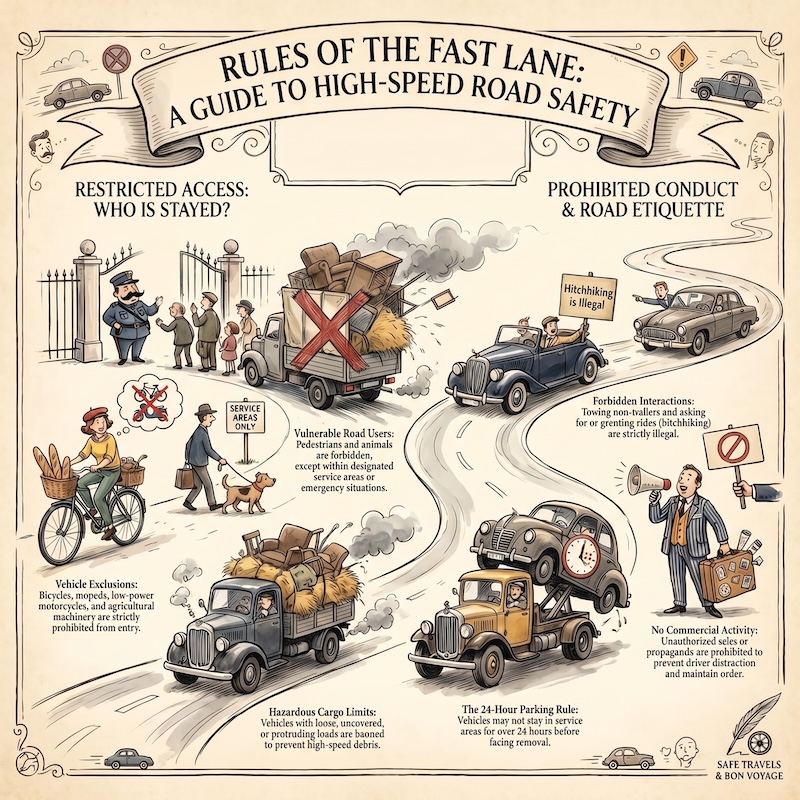
The rules for driving on motorways and main extra-urban roads are stricter than ordinary road rules because these are roads where vehicles travel at high speed and where incorrect behavior can create very dangerous situations. The same rules may also apply to other roads specifically identified by official measure and marked with appropriate start and end signs.
Not all vehicles are allowed to travel on motorways and main extra-urban roads. For example, bicycles, mopeds, many motorcycles with insufficient engine capacity or power, agricultural machinery, work machines, vehicles without tyres, and vehicles whose load, size, condition, or load arrangement may create danger are excluded. In practice, only vehicles with suitable technical characteristics and able to maintain safe speeds and safe driving conditions may use these roads. An important exception concerns certain motorcycles with sufficient engine size or power, which may use these roads only if ridden by an adult.
Vehicles with disordered loads, loads not properly secured, uncovered loads that may disperse, or loads protruding beyond the permitted limits may not circulate on these roads. This is because at high speed even a small loss of material may cause very serious accidents. The same principle applies to vehicles whose equipment or tyres are dangerous or unsuitable for high-speed traffic.
Pedestrians and animals may not circulate on motorways and main extra-urban roads. The exceptions are service areas and rest areas, where animals may be present only if properly controlled. Pedestrians may walk along the emergency lane only to reach emergency call points. This rule exists to prevent particularly vulnerable road users from being exposed to the dangers of fast traffic.
On carriageways, ramps, junctions, service areas, parking areas, and other motorway facilities, certain specific behaviors are prohibited. It is forbidden to tow vehicles other than trailers, to ask for or offer lifts, to carry out commercial or promotional activities unless specifically authorized in service or parking areas, and to camp except in areas expressly intended for that purpose. Even in areas adjacent to motorways, commercial or promotional activities directed at motorway users are prohibited.
In service areas, parking areas, and other motorway facilities, vehicles may not remain parked for more than twenty-four hours, except in special cases such as parking reserved for hotels or similar facilities. After that period, the vehicle may be forcibly removed. Vehicles that appear abandoned may also be removed.
Roadside assistance and vehicle removal on motorways and similar roads are allowed only to bodies and companies authorized by the road owner, except for the armed forces and police in the cases provided by law. This ensures that interventions are carried out safely and in an orderly way in a high-risk environment.
Anyone who violates these rules is subject to administrative penalties. Some violations, such as those involving dangerous loads or prohibited commercial activities, lead to very high fines and, in some cases, also to administrative detention of the vehicle. When police discover a vehicle that is not allowed or not suitable for these roads, they order the driver to leave the motorway or main extra-urban road and provide the necessary assistance to ensure that this is done safely.
For theory exam preparation, it is important to remember the general principle: motorways and main extra-urban roads are reserved for vehicles and behaviors compatible with fast, continuous, and safe traffic. Everything that slows traffic, obstructs it, or increases danger, such as unsuitable vehicles, pedestrians, animals, dangerous loads, or activities unrelated to traffic, is prohibited or strictly limited.
Studied the theory? Test yourself with 7,000+ official Italian Ministry questions.
📝 Start now with SuperQuizPatente