
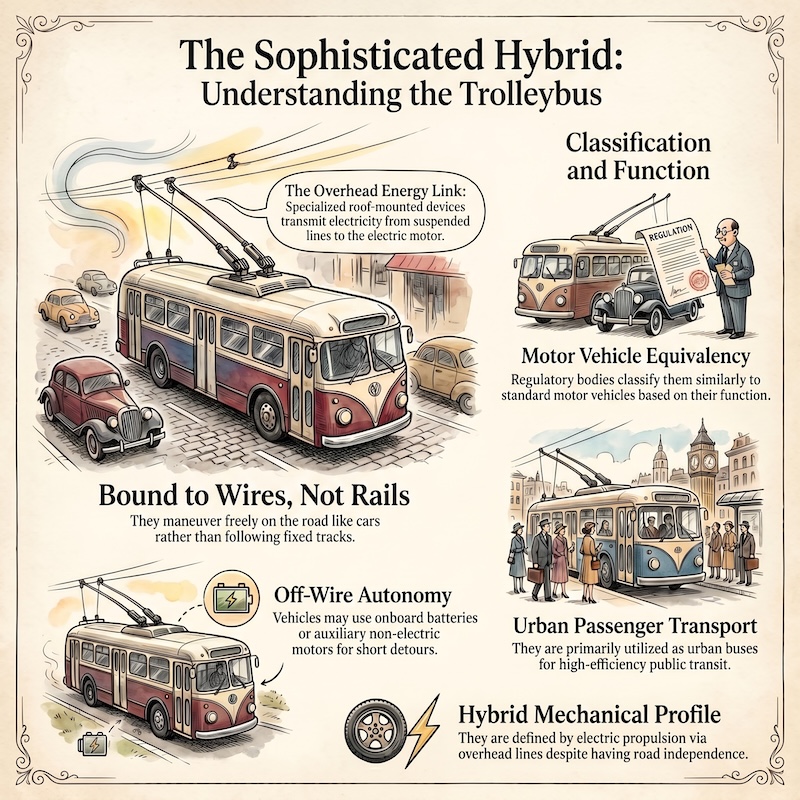
Trolleybuses are electric motor vehicles that move on roads without being constrained by rails, but they receive power through a connection to an overhead electric line. Unlike trams, they do not run on tracks and can move freely on the road like other vehicles, while still being powered by overhead wires.
The connection to the overhead line is made through specific devices mounted on the vehicle, which transfer the electrical energy needed for operation. However, the law allows trolleybuses to be equipped with an auxiliary motor that can be used when the overhead power supply is not available. This additional motor does not necessarily have to be electric and is useful for short movements or special situations, such as route deviations.
Trolleybuses may also be equipped with onboard energy sources, such as batteries, allowing them to operate independently from the overhead line for limited distances.
In terms of classification, trolleybuses can fall into the same categories as motor vehicles, depending on their function. For example, they are commonly used for passenger transport in urban areas.
For the theory exam, it is important to remember that trolleybuses are electric vehicles that operate without rails but are mainly powered by overhead electric lines, with possible auxiliary systems for movement.
Studied the theory? Test yourself with 7,000+ official Italian Ministry questions.
📝 Start now with SuperQuizPatente