
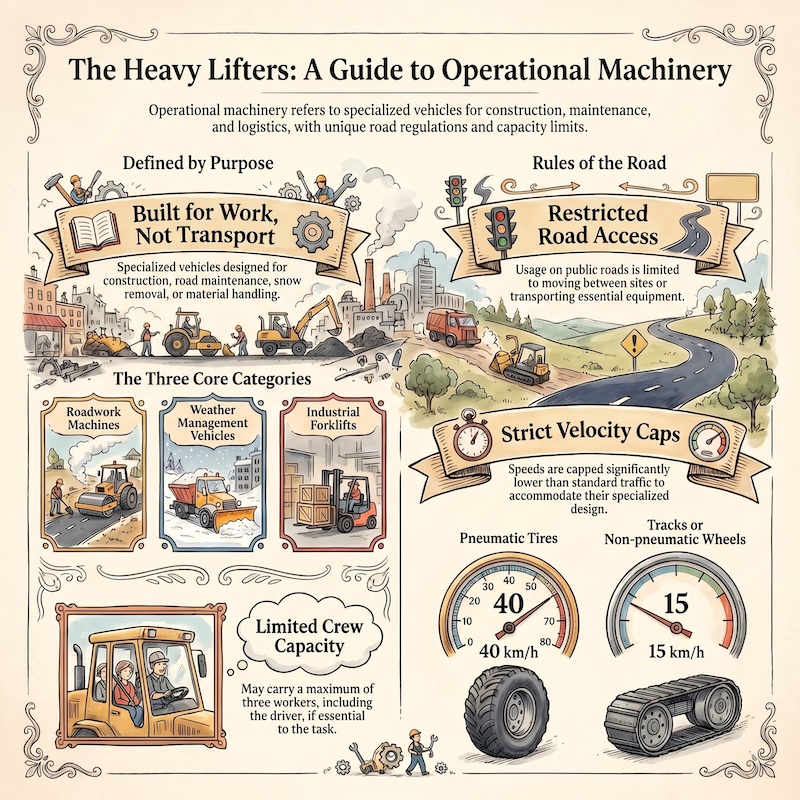
Work machines are special vehicles, either self-propelled or towed, equipped with wheels or tracks, designed mainly to perform specific tasks on roads or in construction sites. They are not intended for normal transport of people or goods, but for activities such as construction, maintenance, snow removal, or material handling.
These vehicles are allowed to circulate on roads only in connection with their operational purpose. They may move between work locations or transport materials needed for their activities. They are not meant for regular road use, and their circulation is limited to work-related needs.
From a classification point of view, work machines include various types. These include vehicles used for construction and maintenance of civil works or road infrastructure, such as roadwork machines. They also include vehicles used for traffic management in specific conditions, such as snowplows and salt spreaders. Forklifts and similar vehicles used for moving goods in industrial or logistical environments are also part of this category.
Some work machines may carry a limited number of people, but only those directly involved in the work and no more than three, including the driver.
Regarding speed, these machines are subject to specific limits. Work machines must not exceed 40 km/h on the road. If they have non-pneumatic wheels or tracks, the limit is reduced to 15 km/h. This is because they are designed for work rather than for fast travel.
For the theory exam, it is important to remember that work machines are vehicles intended for operational tasks, can circulate on roads only when necessary for their function, and are subject to stricter limits on speed and use.
Studied the theory? Test yourself with 7,000+ official Italian Ministry questions.
📝 Start now with SuperQuizPatente