
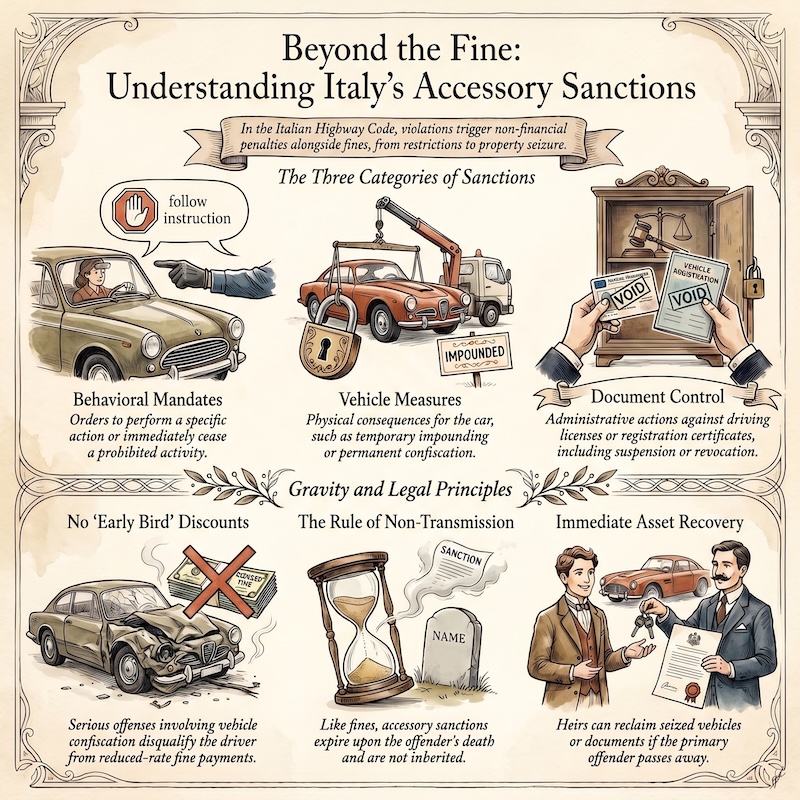
In the Highway Code, in addition to a monetary fine, there may also be an additional penalty, which is a consequence that does not involve the payment of money. When the law provides for it, this additional penalty is applied automatically, without the need for a separate decision.
Additional penalties are divided into three main categories. The first concerns obligations or prohibitions, such as the requirement to perform a specific action or to stop or suspend an activity. The second concerns the vehicle itself, for example measures such as seizure or confiscation. The third concerns driving documents, such as the driving licence or registration certificate, which may be suspended, withdrawn, or revoked.
In more serious cases, such as when confiscation of the vehicle is предусмотрено, the reduced payment option is not allowed. This means that the offender cannot benefit from a discount for early payment. In such cases, the report must be sent to the prefect within a short time for further decisions.
An important principle is that additional penalties follow the same rule as the main fine regarding inheritance. If the person responsible dies, not only does the obligation to pay the fine cease, but all additional penalties and related procedures also end. For example, if the vehicle was seized or documents were withdrawn, the heirs can request their return.
Studied the theory? Test yourself with 7,000+ official Italian Ministry questions.
📝 Start now with SuperQuizPatente