
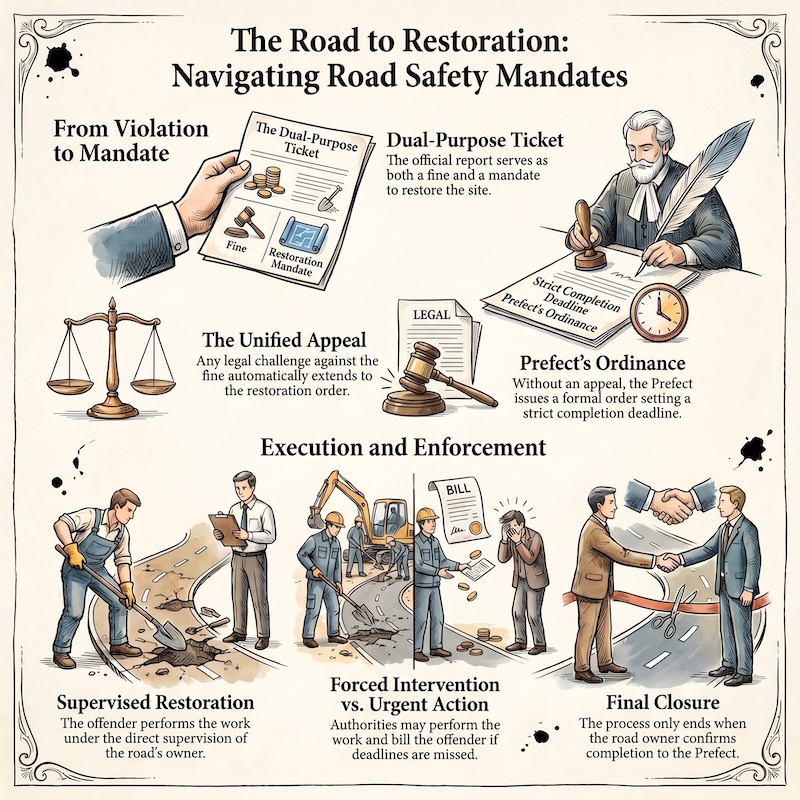
In some cases, in addition to a fine, the law requires the restoration of the original state of the place or the removal of illegal works carried out in violation of road regulations. This may occur, for example, when someone unlawfully modifies a road, installs unauthorized structures, or creates situations that endanger traffic safety.
When such a violation is identified, the officer clearly indicates in the report the obligation to restore the area or remove the illegal works. The report itself serves as the legal basis for both the fine and the additional penalty.
If the offender files an appeal against the fine, it automatically includes the additional penalty. If no appeal is filed, the report is sent to the prefect, who issues an order requiring both payment of the fine and completion of the required works within a specified time.
The offender must carry out the restoration or removal under the supervision of the road authority. Once the work is completed, the authority informs the prefect, who declares the procedure closed.
If the offender fails to complete the works within the given time, the road authority may carry out the work itself. In this case, the costs are charged to the offender through an enforceable order issued by the prefect.
In urgent cases, where there is an immediate danger to traffic or the offender cannot act, the prefect may order the necessary works to be carried out immediately.
If the prefect considers the violation unfounded, the dismissal also applies to the additional obligation. Any judicial appeal also automatically extends to the additional penalty.
Studied the theory? Test yourself with 7,000+ official Italian Ministry questions.
📝 Start now with SuperQuizPatente