
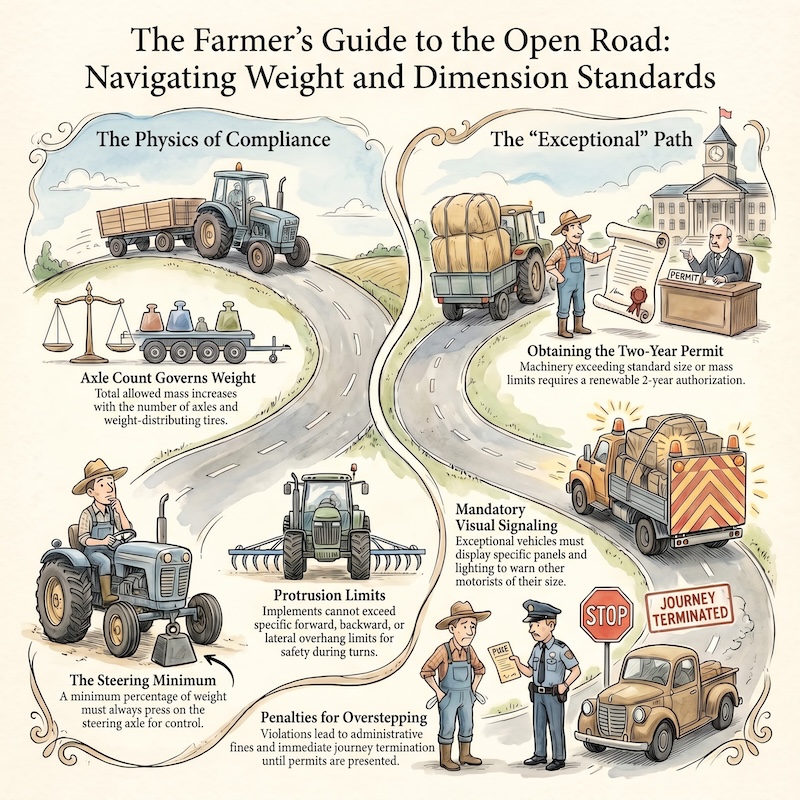
Agricultural vehicles that use public roads must comply with precise limits for size and weight. As far as maximum dimensions are concerned, the general rules that apply to vehicles and trailers also apply to agricultural machines. This means that when agricultural vehicles leave fields and travel on public roads, they must stay within specific measurements so they do not create danger or obstruction.
The maximum total weight of wheeled agricultural machines depends on the number of axles. In general, the limit is lower for vehicles with one axle and higher for those with two or more axles. However, if the machine has tyres that distribute weight well on the ground and, in vehicles with three or more axles, the distance between adjacent axles is sufficient, higher weight limits may be allowed. This is because better weight distribution reduces damage to the road and improves vehicle stability.
The law limits not only the total vehicle weight but also the maximum load allowed on a single axle or on two nearby axles. These limits are meant to protect the road surface and avoid excessive stress on the carriageway. In practice, it is not enough to look only at the total weight of the vehicle; the way that weight is distributed is equally important.
For self-propelled agricultural machines, the weight resting on the steering axle is also important. Even when the vehicle is unloaded or in normal driving condition, a minimum part of the total weight must rest on that axle. This rule ensures that the vehicle keeps proper steering ability and remains controllable. For slower vehicles and semi-tracked machines, this minimum percentage is slightly lower.
Tracked agricultural machines also have a specific maximum total weight. This means that even though their structure differs from wheeled vehicles, they still have clear limits when circulating on roads.
When an agricultural tractor travels with mounted or semi-mounted equipment, special rules apply to the front, rear, and side overhangs. The equipment cannot extend too far in front of or behind the tractor, and the side projection must also remain within established limits. In addition, the total length of the whole combination cannot become excessive. These rules help prevent dangerous overhangs, especially on bends, intersections, or narrow roads.
The total weight of the tractor together with the attached equipment must also remain within the permitted limits. It is therefore not enough for the equipment simply to be attached to the vehicle; the whole combination must remain safe and compliant in both size and mass. The attachment systems must also prevent unwanted movement during transport, so that the equipment does not swing and create instability or danger for other road users. Only in certain special cases, such as equipment fitted with freely swivelling wheels, is this rule adapted.
If an agricultural machine exceeds the normal size or weight limits, or if a tractor with mounted or semi-mounted equipment does not fall within the allowed limits, the vehicle is considered exceptional. In this case it cannot circulate freely on the road and must have a specific authorization. This authorization is valid for two years, can be renewed, and is issued by the competent authority depending on the type of road involved.
Exceptional agricultural machines must also be fitted with panels and visual warning devices to clearly show the vehicle’s overall dimensions. In addition, special precautions and conditions set by the regulations and by the authorization must be respected while driving. The purpose is to increase safety and warn other road users that the vehicle is unusually large or heavy.
Anyone who drives an agricultural machine exceeding the permitted size or weight limits is subject to administrative penalties. Penalties also apply to anyone using an exceptional agricultural vehicle without respecting the rules on equipment locking, warning devices, or the conditions stated in the authorization. If the driver does not have the authorization with them, the journey cannot continue until it is shown. In some cases, in addition to the fine, further accessory sanctions also apply.
Studied the theory? Test yourself with 7,000+ official Italian Ministry questions.
📝 Start now with SuperQuizPatente