
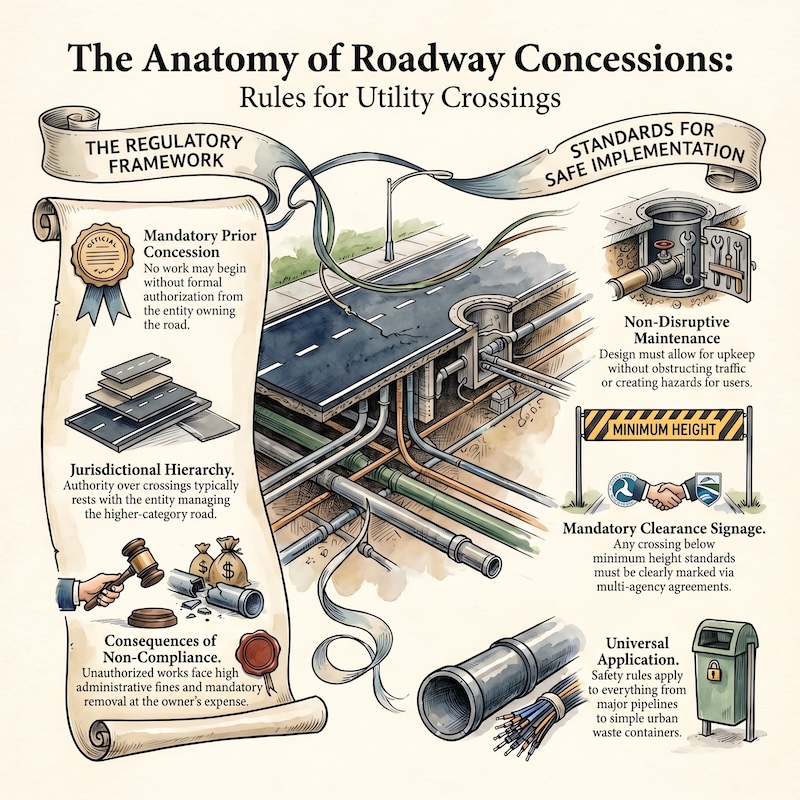
It is not possible to build crossings or use the road area and its appurtenances without prior permission from the road authority. This rule applies to many different works, such as waterways, water pipelines, electricity or telecommunications lines, whether overhead or underground, underpasses, overpasses, cableways, gas pipelines, liquid fuel tanks, and any other installation that may affect road property. The purpose of this rule is to ensure that such works do not compromise traffic safety or damage the road.
When these works are authorized, they must be designed and built in a way that does not obstruct traffic and allows maintenance without interfering with circulation. In practice, the installation must be usable and maintainable without blocking the road or creating risks for vehicles and other users. For this reason, access to the works should, as far as possible, be provided from the side areas belonging to the road.
In the case of underpasses and overpasses between two roads belonging to different authorities, the law clearly establishes who is responsible for the construction and maintenance of the main structures, including safety barriers on overpasses. In general, when a lower-category road crosses a higher-category road, responsibility for the main structure belongs to the authority connected with the more important road. For motorways and main extra-urban roads, this principle is even stricter, because of safety needs and the importance of traffic flow. The authorities involved must also regulate by specific agreements how obligations and costs are shared in practice.
If an existing crossing has a clearance height lower than the minimum required by technical rules, it must be properly signaled. This signaling must also be governed by an agreement between the authorities responsible for the infrastructures involved, because insufficient clearance can create a serious risk for taller vehicles.
Permits are granted only in cases of absolute necessity and after a technical assessment by the competent authority. This means that it is not enough simply to request permission: it must be shown that the work is truly necessary and can be carried out without affecting road safety and road function.
Even elements that may seem simple, such as urban waste containers, must be placed so that they do not create danger or obstruction to traffic. Therefore, anything that occupies or affects the road area must always be positioned with visibility, vehicle movement, and pedestrian movement in mind.
Anyone who builds works or installations without permission, changes their use, or keeps them in operation without authorization commits a serious violation and is subject to a high administrative fine. In addition, unauthorized works must be removed at the offender’s expense. Anyone who fails to respect the conditions contained in the permit or in the regulations is also subject to penalties and may face suspension of the activity until all required conditions are met. For the theory exam, it is important to remember that any crossing or special use of the road area requires prior permission and must always be compatible with safety, visibility, and the regular flow of traffic.
Studied the theory? Test yourself with 7,000+ official Italian Ministry questions.
📝 Start now with SuperQuizPatente