
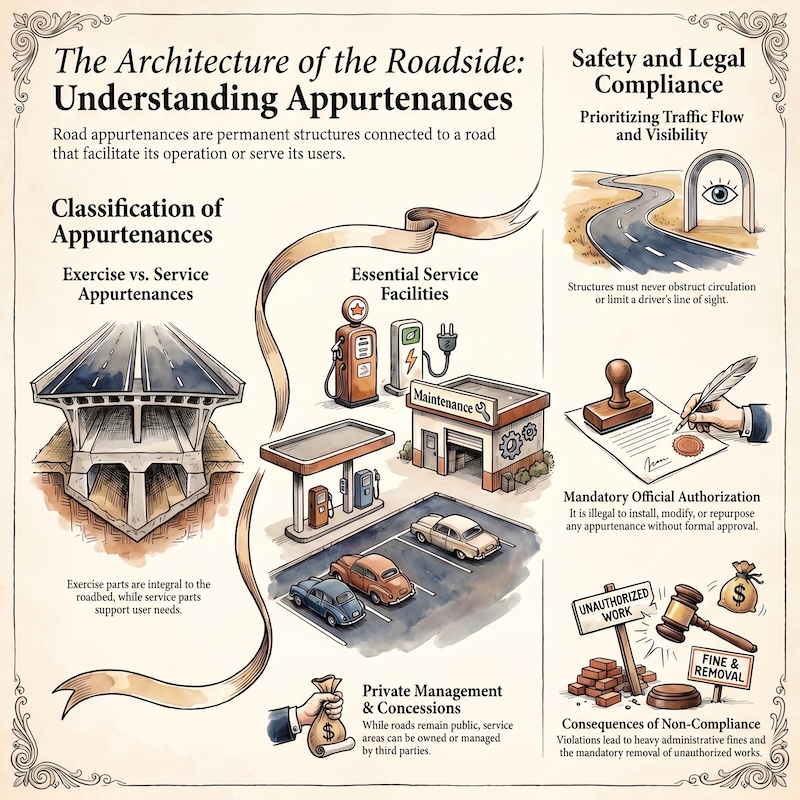
Road appurtenances are all the parts permanently connected to the road and intended for its operation or for serving road users. They are not just the carriageway itself, but also spaces and structures that support the road on a permanent basis, such as service areas, parking areas, fuel stations, charging points, or buildings used for road maintenance.
Road appurtenances are divided into two main categories. Operational appurtenances are those that form an integral part of the road or are permanently connected to the roadway itself. Service appurtenances, on the other hand, are spaces or structures intended to assist users or support road management. This category includes service areas, parking areas, fuel or charging facilities, rest facilities, and buildings used for road maintenance.
Service appurtenances must be located and organized in a way that does not obstruct traffic and does not reduce visibility. Their position and layout must always remain compatible with road safety. The road authority decides how to identify these areas according to the rules laid down in the regulations.
Some appurtenances, such as service areas, parking areas, charging points, and refreshment facilities, may also belong to persons other than the road authority or may be granted in concession to third parties. In practice, the road remains public, but some of the related services may be managed by companies or other authorized subjects.
In the case of motorways, service appurtenances must be planned consistently with the motorway project and with traffic safety needs. This applies, for example, to the organization of service areas, refueling points, commercial activities, and electric charging stations. In these cases too, everything must be approved through specific procedures.
It is forbidden to install equipment or build structures without the required authorization. It is also forbidden to modify those structures or change their use without permission. Anyone who does so commits a serious administrative violation.
Even when authorization exists, all the conditions contained in it must be respected. If those conditions are not followed, administrative penalties apply. In addition, if the structure is unauthorized, its removal is ordered at the offender’s expense. If the problem is the failure to respect the authorized conditions, the activity may be suspended until the required corrections are made. Later compliance with the rules does not remove the obligation to pay the penalty.
Studied the theory? Test yourself with 7,000+ official Italian Ministry questions.
📝 Start now with SuperQuizPatente